
In the previous essay, we explored ancient Jewish apocalypticism and saw that the concept of the apocalypse originally meant much more than simply the destruction of the world. It was a way of understanding history, one in which God would intervene, evil would be defeated, the dead would be raised, and a new age would emerge. In this essay we’re going to continue that discussion by looking at how the message of Jesus fits squarely in the framework of apocalypticism.
Who was the Historical Jesus
Specifically, we’re going to ask a question that has occupied scholars for more than a century: Who was the historical Jesus? This may sound like a strange question. After all, haven’t billions of people already answered it? Christians believe Jesus was the Son of God, the Messiah, and the savior of humanity. But historians ask a slightly different question. They want to know who Jesus was within his own historical context, before centuries of doctrine and theology accumulated around him.
To do that, we need to place Jesus back into the world in which he lived. He was not a modern American Christian. He was not a medieval Catholic. He was not a Protestant reformer. He was a first-century Jew living under Roman occupation during the Second Temple Period. And when we place him back into that world, a different picture begins to emerge.
The scholar most responsible for this shift was Albert Schweitzer. In 1906, he published a landmark study arguing that Jesus was best understood as an apocalyptic prophet. More than a century later, this remains the dominant view among New Testament scholars. While there is disagreement over some of the details, most scholars agree that Jesus proclaimed the imminent arrival of the Kingdom of God and believed that history was approaching a dramatic turning point.
That conclusion may surprise many modern Christians, because when people think of Jesus today, they often think of a moral teacher, a miracle worker, or a divine savior. But for Jesus and his earliest followers, the coming Kingdom of God was central to their belief. It was the lens through which they understood the world.
Reconstructing Jesus
Before we get to Jesus himself, however, we need to briefly discuss how historians know anything about him at all. Unlike many figures from antiquity, we actually possess a substantial amount of information about Jesus. We have the letters of Paul, written roughly twenty years after Jesus’ death. We have the four canonical gospels. We have the Book of Acts. And we even have a few references outside the Bible, most notably from the Jewish historian Josephus.
None of these sources are perfect, however. The gospels were not written as modern biographies. They are theological documents written by believers who were trying to persuade others of who they thought Jesus was. But historians work with imperfect sources all the time. The task is to compare these different traditions, identify points of agreement, and reconstruct what is most likely historical.
When we do that, a handful of facts emerge that are accepted by an overwhelming majority of scholars. Jesus was a real historical person. He was from Nazareth. He was baptized by John the Baptist. He carried out a ministry primarily in Galilee. He traveled to Jerusalem around Passover. And he was executed by the Romans through crucifixion. But the real question for us is not whether Jesus existed, it is instead ‘what was his message?’
John the Baptist and the Apocalyptic Movement
To answer this question, it helps to look at another important figure from Jesus’s time, John the Baptist, and Jesus’s relationship with him. John appears not only in the gospels but also in the writings of Josephus, giving us strong evidence that he was a real historical figure. His message was straightforward and urgent: repent, because the Kingdom of Heaven is near.
In Matthew’s gospel we read:
“In those days came John the Baptist, preaching in the wilderness of Judaea, and saying, Repent ye: for the kingdom of heaven is at hand.”
And in Luke’s version, John becomes even more dramatic:
“And now also the axe is laid unto the root of the trees: every tree therefore which bringeth not forth good fruit is hewn down, and cast into the fire.”
This is classic apocalyptic language. Judgment is coming and the old order is about to be overturned. But what is also noteworthy is John’s response when people ask him what they should do about the coming judgement, his answer isn’t complicated theology. He tells people to share what they have with those in need. If you have two coats, give one away. If you have food, share it.
In other words, apocalyptic expectation is immediately tied to ethical action. This pattern becomes central to Jesus’s message as well: the Kingdom is coming so we must change how we live.
The Original Gospel
Jesus’ public ministry begins immediately after John the Baptist’s. In fact, one of the strongest pieces of evidence that Jesus belonged to the broader apocalyptic movement is that he was baptized by John himself. This was probably an embarrassing fact for later Christians, because if Jesus was sinless and greater than John, why would he submit to John’s baptism? Yet the story appears in all four gospels. Historians often see this as a sign that it is likely authentic.
After John’s arrest, Jesus takes up the message and begins proclaiming it throughout Galilee. Mark, which most scholars believe was the earliest gospel, summarizes Jesus’ message in just a few lines:
“Now after that John was put in prison, Jesus came into Galilee, preaching the gospel of the kingdom of God, and saying, The time is fulfilled, and the kingdom of God is at hand: repent ye, and believe the gospel.”
This is a remarkable passage because it tells us what Jesus himself considered to be the “good news.” Notice that it is not yet about his death, resurrection, or salvation through faith. Those ideas would become central to later Christian theology. Here, the good news is that the Kingdom of God is arriving. The original gospel or good news was an announcement that a new age was breaking into history, that God’s reign was beginning, and the old world was passing away.
Luke’s gospel preserves a similar moment. Jesus stands in a synagogue and reads from the prophet Isaiah:
“The Spirit of the Lord is upon me, because he hath anointed me to preach the gospel to the poor… to heal the brokenhearted, to preach deliverance to the captives… to set at liberty them that are bruised.”
Again, the emphasis is not on escaping the world. It is on the arrival of God’s kingdom within the world.
This helps explain another aspect of Jesus’ ministry that often confuses modern readers: his miracles. Many people today see the miracles primarily as proof that Jesus was divine. But from an apocalyptic perspective, they served another purpose. They were signs that God’s kingdom was already beginning to break into the present age. When John sends messengers to see if Jesus is the Messiah, Jesus responds:
“Go and shew John again those things which ye do hear and see: the blind receive their sight, and the lame walk, the lepers are cleansed, and the deaf hear, the dead are raised up, and the poor have the gospel preached to them.”
In Luke 11, Jesus explicitly connects exorcisms to the Kingdom of God when he says:
“But if I cast out devils by the finger of God, no doubt the kingdom of God is come upon you.”
For Jesus, these acts were evidence that God’s power was already advancing against the forces of evil. Now, none of this means that Jesus was simply predicting the end of the world. In fact, one of the biggest misconceptions people have about apocalyptic prophets is that they are only interested in destruction. But as we discussed previously, apocalypse was fundamentally about transformation where the old world gives way to a new one.
Living the Kingdom Now
Jesus’s response to the coming Kingdom was simple: begin living according to the values of the Kingdom now. This answer appears throughout his teachings. Love your enemies. Bless those who curse you. Forgive others. Give to the poor. Do not retaliate. Treat others as you would want to be treated. Be merciful. Care for the vulnerable.
These teachings were not simply timeless moral principles floating in isolation. They were, in Jesus’ view, the way people prepared themselves for God’s coming kingdom. Or perhaps even more importantly, they were the way people began living in that kingdom now.
One of my favorite examples comes from the Lord’s Prayer. Many of us know the line:
“Thy kingdom come. Thy will be done in earth, as it is in heaven.”
Think about what that actually means. The prayer is not asking for escape to Heaven, instead it is committing to implementing God’s will here on Earth. The Kingdom of God is not merely a heavenly destination. It is a vision of a world reordered according to justice, compassion, and the will of God.
This also helps explain Jesus’ repeated warnings about wealth and power. Again and again, he criticizes systems of domination. He warns that one cannot serve both God and wealth, and he condemns religious leaders who seek status and prestige. He praises generosity. He elevates the poor, the widow, the outcast, and the marginalized.
In the story of being tempted in the wilderness, Jesus even rejects political domination itself when offered authority over the kingdoms of the world. His vision of the kingdom was not based on conquest, rather it was based on service. Not domination, but compassion. Not power over others, but responsibility toward them.
A Message for Our Time
This, I think, is where the historical Jesus still speaks powerfully to our own age. We live in apocalyptic times too. Our anxieties may center on artificial intelligence, climate change, nuclear weapons, pandemics, inequality, and political instability rather than Roman occupation. But the underlying question remains remarkably similar: How should we live during times of uncertainty and upheaval?
Jesus’ answer was not to withdraw from society. It was not to obsess over dates, predictions, or timelines. It was not to wait passively for rescue. His answer was to begin living the values of the coming kingdom now. We should care for the poor, lift up the vulnerable, love one’s enemies, and build communities grounded in compassion.
Whether or not Jesus was correct about the timing of God’s intervention, his prescription for navigating turbulent times remains profoundly relevant. As a carpenter myself, I can’t help but appreciate one of the parables attributed to Jesus about two builders.
“Therefore whosoever heareth these sayings of mine, and doeth them, I will liken him unto a wise man, which built his house upon a rock: and the rain descended, and the floods came, and the winds blew, and beat upon that house; and it fell not: for it was founded upon a rock. And every one that heareth these sayings of mine, and doeth them not, shall be likened unto a foolish man, which built his house upon the sand: and the rain descended, and the floods came, and the winds blew, and beat upon that house; and it fell: and great was the fall of it.”
We can see in this parable what was truly important for Jesus: for people to hear what he was saying and then act on that. For the historical Jesus, his focus was not on his death and resurrection. It was about hearing his message on the Kingdom’s ethics and putting it into practice.
What strikes me most is that Jesus’ response to apocalyptic anxiety was not fear. It was action. It was to live as though the Kingdom (or the future you hope for) is already beginning to emerge. Whether one is religious or not, that’s a powerful response to uncertainty.
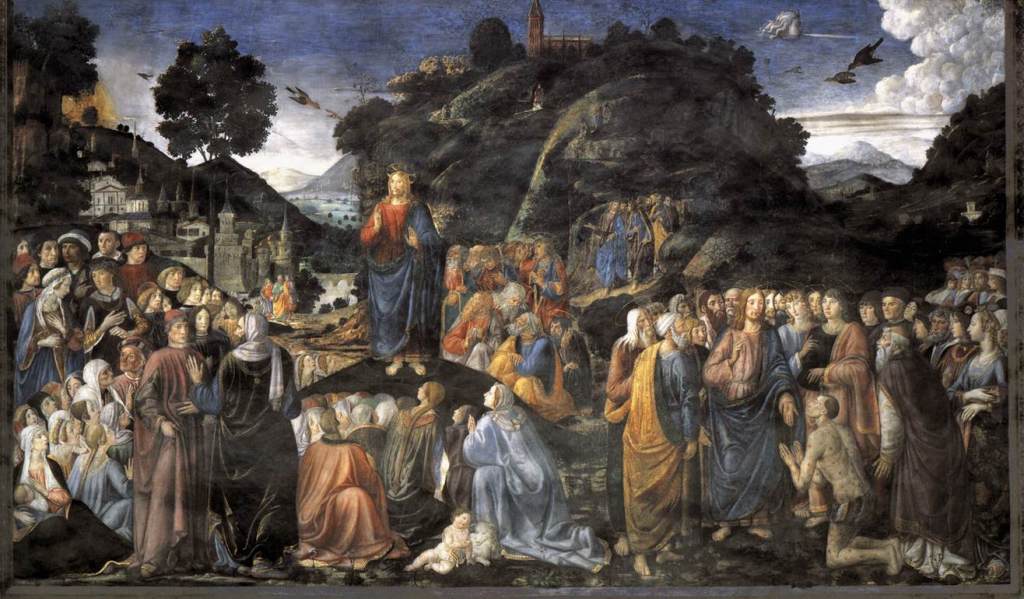
Cover image is Sermon on the Mount by Cosimo Rosselli, 1482. Source image found here.
This essay is part two of a three-part series that deals with apocalyptic thought and its influence on modern society. You can read the other essays from the links below:
Part 1 – The Origins of Apocalyptic Thinking
Part 3 – Is The Rapture Actually In The Bible?
This essay develops themes explored more fully in my recently published book, The Last Apocalypse: Consciousness, Revelation, and the Future of Humanity
 Building the Future Now