A Blog proposing a new economy

  • Cooperatives and a New Economy

    In some of my previous blog posts, I mentioned cooperative businesses and a cooperative-based economy as an alternative to Capitalism and conventional-style corporations. But because cooperatives as a business form are not really well-known, I’d like to briefly explain them. 

    To begin, a very basic and broad definition of a cooperative business is where the workers own the business and make decisions about its operation. It is democracy in the workplace, democracy in the economic sphere. This cooperative model directly challenges the ownership model in our current capitalist system.

    In a worker cooperative, the ownership is moved from CEOs and shareholders to the workers themselves. They become the shareholders. The profits of the business go to the workers. But the responsibilities in running it as well fall to them. In most worker-owned cooperatives, each member gets one vote in the decision making process. The worker-owners make decisions through a democratic process, which can vary from company to company. 

    In order to help ensure that the business is profitable and tasks are being completed, the workers can elect a supervisor or even a management team, depending on the size of the cooperative. So it is not completely non-hierarchical, it is just that the decisions about the hierarchy are made democratically among the workers. 

    This bottom-up control has many advantages. One is efficiency. Workers that directly benefit from hard work and figuring out ways to save time and money will usually do just that. Having hands-on experience in the decision making process helps avoid the dumb decisions that we all know comes from the top, wherever we work. 

    Workers cooperatives also help pull wealth down from the upper tier of the economic system – from the wealthy – to the worker-owners who often live in or near the communities in which they work. Worker ownership helps anchor wealth in communities, instead of it being extracted by large corporations such as Walmart. 

    Many worker cooperatives have a specified ratio between the highest paid worker and the lowest paid worker. It can be 9 to 1, 7 to 1, or 5 to 1 depending on what the workers in the company decide. This helps wealth to not be concentrated among the top tiers of the company, while still allowing for some upward mobility and incentives for career growth. 

    Here are a couple examples of worker-owned cooperatives operating in the United States in a range of industries. 

    New Era Windows

    This worker-owned cooperative based in Chicago sells energy-efficient windows throughout the United States. They formed after an abrupt closure of the plant in 2008, eventually purchasing the company in 2012. By 2015 they had 20 employees and were generating around 1 million in revenue per year. They are still going strong today. 

    Namaste Solar

    Namaste is a major solar installation company in Colorado that has been operating for over 20 years. It currently has over 60 worker-owners, and is a top rated solar company. 

    Select Machine, Inc.

    This machining shop was sold by the retiring owner to the workers, becoming a cooperative in 2010. It is located in northeastern Ohio, and it currently has 11 worker-owners. It specializes in metal applications for construction projects.  

    Palante Technology Cooperative

    Palante Tech Cooperative formed in 2010, and provides technological services to non-profit corporations and other similar organizations. There are currently 8 worker-owners at the company. 

    These are all examples of worker cooperatives around the United States. A current estimate of the total number of American cooperatives, though, is only around 612. Compared to the rest of the world, worker cooperatives represent a small slice of the business landscape here in the United States. Increasing that number could result in a ground shift in our economy and society. 

    Mondragon Corporation

    To see an economy composed of cooperative businesses at a larger scale, we can look at the Mondragon Corporation in the Basque Region of Spain. Mondragon is a federation of ninety-five cooperatives that make a wide range of products. Mondragon operates in four economic sectors, Manufacturing, Retail, Finance, and Education, and is the seventh largest corporation in Spain. It employs about 70,000 people, 80% of whom are worker-owners. 

    The impact that this corporation has had on the community around it is enormous. In the town of Mondragon where it was founded, it has been noted that there is not extreme wealth, but there is not any poverty. A majority of the townspeople have shares in the company. This extends to the communities around Mondragon where many of the cooperative businesses are themselves located. This has helped the overall Basque Region, which historically has been a less economically developed area, turn into a more prosperous one.

    All in all, cooperative businesses provide more wealth and stability for the workers and communities where they are located. During the economic downturn in 2008, Mondragon as a federation of cooperatives spanning multiple industries, was able to avoid mass layoffs by shifting workers from impacted industries to ones that were affected less. This took sacrifice on the part of all the workers in the company, and it was a very different decision than the executives and shareholders in capitalist corporations made.

    Cooperative businesses still operate under the same forces of competition and the need for innovation just like any other business. So a cooperative economy still has those same forces just like our current capitalist system.

    The primary difference is who owns the company, who makes the decisions, and who profits from it. It makes so much more sense that the workers in the business should be the ones in charge. What do most shareholders really know about the day to day operations of a specific company? Almost nothing. 

    I want to make it clear that I am not selling a utopian dream. Cooperatives are difficult, they take time and effort. It entails making business decisions with your coworkers. Not all cooperatives are successful, just like any business. And working in a cooperative is not for everyone. That’s okay.

    But for those of who want something different, who want to make an impact with our work, cooperatives are the way to go. They are the ultimate team ball, we’re just playing a different game than Capitalism.  

    Additional Reading:
    What is a Worker Cooperative?

    Spanish Town Without Poverty

    How Mondragon Became the World’s Largest Co-Op

  • Is Capitalism Really Responsible for our Modern World, Part 2

    Part 2: The Role of the Public Sector in Innovation 

    One of the primary justifications for Capitalism is that it is the cause behind our modern world, creating the comforts and health benefits we all enjoy. This is the second part of an essay that critically examines that claim. In this part, I will be focusing on the impact of research and innovation that has come from the public sector. 

    The term “public sector” means any sort of research funded by public money, whether through federal, state, or local governance. This means the military, public universities, and governmental agencies such as NASA and the National Institute of Health. 

    Starting with the US military, there have been a multitude of innovations that have come from the Defense Department. Maybe one of the most profound innovations is that of the internet. The prototype for this was developed by DARPA, a highly innovative research arm of the US military. In addition, most of the developments in computer technology and science in the early years of computing were from publicly funded universities.

    So much of our modern world is based upon this foundational development of computing and the internet. Over one trillion dollars of US retail commerce happens online each year. Social networking sites such as Facebook and Twitter exist because of the US military’s invention of the internet in the late 1960s.

    Add to the internet the following list of items that the US military either invented or substantially helped in the development of; the microwave, GPS, jet engines, canned food for mass production, synthetic rubber and fabrics, superglue, jeeps, EpiPens, WD-40, and many other items. The list is pretty exhaustive. And that is just for the US military, not to mention other militaries around the world.

    Another major source of public sector innovation is NASA. Maybe even more than the military, NASA has contributed greatly to our modern way of life. Public funding put a human on the moon and developed most of the technology to put satellites in orbit. Satellites are a critical component of our interconnected world, allowing almost instantaneous communication from almost anywhere on the globe. 

    Beyond satellite and rocket technology, NASA has created or been a major part in the development of the following items: scratch-resistant lenses, memory foam, cochlear implants, freeze-drying, digital cameras, ear thermometers, wireless headphones, advancements in baby formula, cordless power tools, artificial limbs, housing insulation, and solar cells…to name just a few. 

    In the field of medicine, the federal government has played a massive role through agencies such as the NIH, public universities, and research institutions. One of the most notable achievements of publicly funded research is that of the human genome project. Achieved in only 13 years versus the 15 years it was projected to take, this cracking of the human genome has transformed medical research. 

    Beyond this, public funds have funded much of the basic research for medical advancements that is not viable in the capitalist market. A good example is the Nobel Prize winning research of Julian Axelrod at the NIH on neurotransmitters in the brain. This research has led to the development of a wide range of drugs to treat depression. 

    Another major discovery that altered the modern world is that of penicillin. It was discovered by Alexander Fleming, a researcher working on a publicly funded project at a publicly funded hospital in the UK. This discovery is arguably the most significant medical breakthrough in modern history. It allowed for the creation of antibiotics that have saved millions upon millions of lives. The infant mortality rate has seriously decreased because of penicillin, as well as post-surgery deaths from bacterial infections. All in all, the discovery of penicillin has extended the average life expectancy by 23 years. 

    Cancer research is another area where public funding has driven a large share of the innovation. Add to this the fact that insulin was discovered at a public university in Toronto, Canada. Beyond this, I could list a whole host of drugs and medicines discovered from publicly-funded research that benefit people everyday.

    All this shows something very impressive. That we, as a people, have come together and through our elected officials have hired some of the most talented researchers in the world. Researchers who often toil in obscurity, and without the compensation researchers in the corporate world receive, to make all of our lives better. It’s an amazing thing, and it has nothing to do with Capitalism. 

    This doesn’t mean that Capitalism has not come up with innovations and inventions. It has, the automobile is a primary example. But it’s hard to argue that Capitalism is the cause behind innovation when so much of our modern lives was developed through publicly-funded research. 

    In conclusion to this two part series, Capitalism is an economic system where innovation does happen. But it is not the cause of it, and it is not the sole reason that we in the modern world live in comfort and relative prosperity. Humankind has been inventive since we first entered the scene 200,000 years ago. Technology builds upon itself, upon the accumulated skills, experience, and knowledge of millions of unnamed people in the past. 

    That drive for bettering ourselves and our situation is not going to change if we build a new economic system. In fact, a cooperative economy still fosters innovation, and still involves competitive forces. The difference is that the profit from that innovation is not concentrated among the executives and shareholders at the top. 

    All this goes to show that we do not have anything to lose if we give up Capitalism. We can go about our modern lives with the same amount of comfort. But with a lot less poverty around us and a whole lot healthier and wealthier communities. A better future is possible, we just have to build it.  

  • Is Capitalism Really Responsible for our Modern World?

    Part 1: The Acceleration of Technology and Capitalism

    When Capitalism is discussed, one of the main justifications given for it is that due to its focus on innovation and competitive forces, it has driven the technological developments that have created the modern world. All the luxuries, comforts, and extended lifespans that we enjoy are due to Capitalism. 

    It can be hard to argue against this. We look around and we do have a lot more comfort, health, and wealth than what people did before Capitalism. And right around the time Capitalism emerged, there was an acceleration of technological progress. So it has to be true, capitalism is the cause of our modern prosperity as it is. Right?

    Well, that may not actually be correct.  I’m going to argue that the relationship between capitalism and technological progress is not one of causation, but rather correlation. I’ll do this by looking at the long-term trends in technological development, and then in part two of this essay I’ll examine the role of the public sector in modern technological development. 

    To examine the role of Capitalism in the development of technology, we’re going to travel way into the past when modern humans, Homo sapiens, first emerged around 200,000 years ago. One of the earliest technologies associated with hominids, which include species before humans, was that of stone tool technologies. And it is a technology that we have ample evidence of in the archaeological record. 

    Before even modern humans emerged, there were stone tool technologies. The first is known as the Olduwan Industry, and it was a basic form of tool making that involved chipping away flakes from a core cutter or chopper. This lasted from around 2.9 to 1.5 million years before present, or for a span of about 1.4 million years. 

    The next development in stone tool technology was the Acheulean Industry, which lasted from about 1.5 million years before present to about 200,000 years ago. For both of these industries, it took around a million and a half years for each of them to develop to the next stage. 

    But once Homo sapiens were on the scene, with the same brain capacity and physical features as we have today, the development of stone tool technologies accelerated. The stone tool industry that modern humans stepped into was that of the Mousterian Industry, which was already being used by Neanderthals. This Mousterian Industry lasted from around 200,000 years ago until the next stone tool industry came about around 50,000 years ago. This is only a scant 150,000 years for a major technological change to occur, compared to the 1.5 million years in previous industries. 

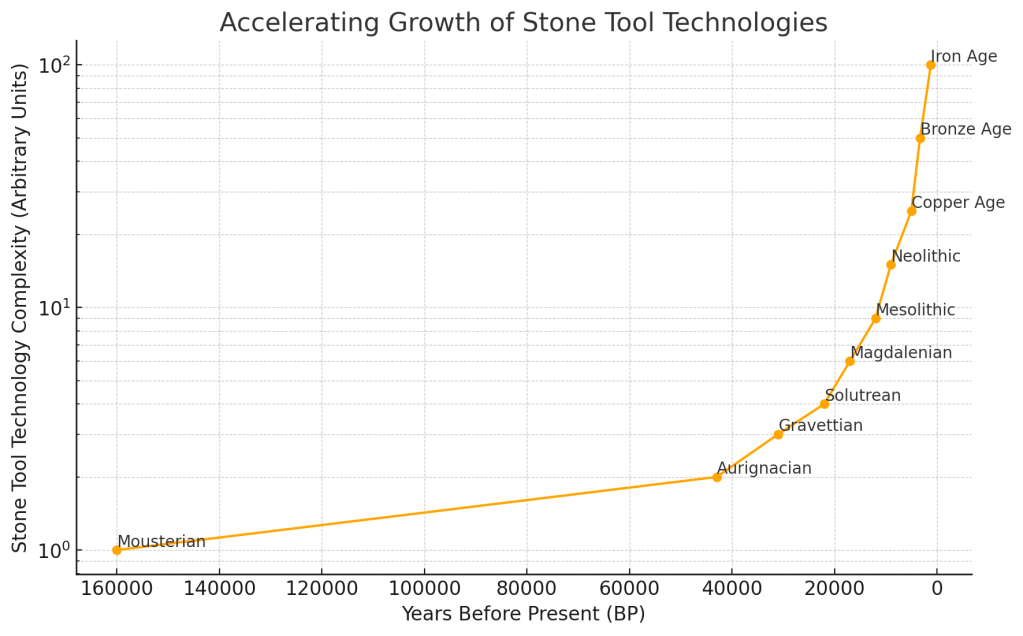
    And this acceleration did not stop until stone tools were replaced with other technologies such as metal working. Looking at the chart below, the exponential rise in stone tool technologies can be clearly seen. 

    Figure 1: Showing the development of stone tool technologies by archaeological phase. 

    One critique of the above chart that could be made is that the phases of stone tool development are ones that archaeologists came up with and may not represent a quantifiable change in technology. So here is another chart looking at the development of cutting edge efficiency, which is a more quantifiable variable.

    Figure 2: Showing development of cutting edge efficiency in stone tool technologies. 

    Inventiveness has always been a part of humanity, and this has been the driver of technological change. As humanity has developed technologies, our base of knowledge has increased and our skills have increased. Each of these factors and more are behind this exponential growth in technological change. Here is a chart showing the development of technology from stone tools until today.

    Figure 3: Showing the exponential growth of all human technology over time.

    When viewed over the long span, we have been on an upward exponential curve really since the Neolithic Era. The invention of Capitalism occurred along with the Industrial Revolution, already far along on the exponential curve. The acceleration was already happening.

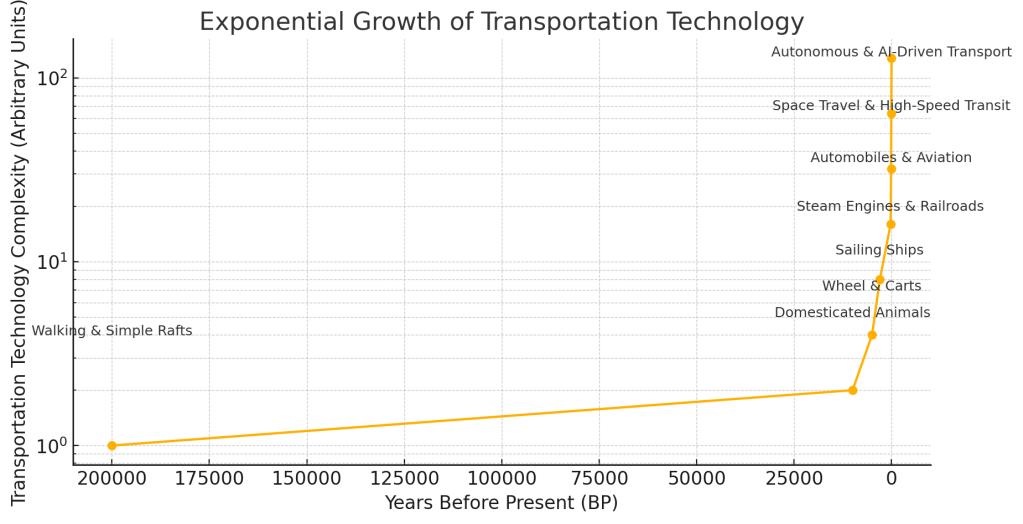
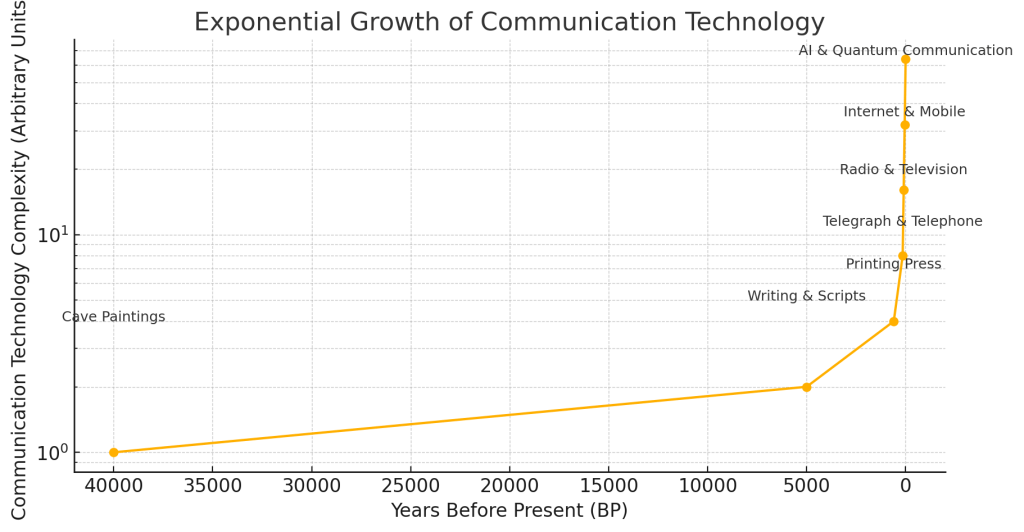
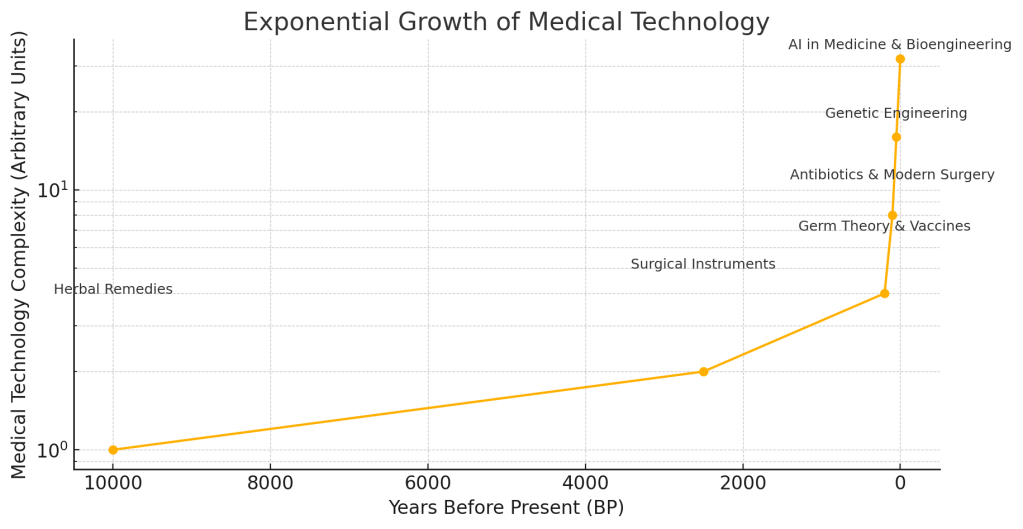
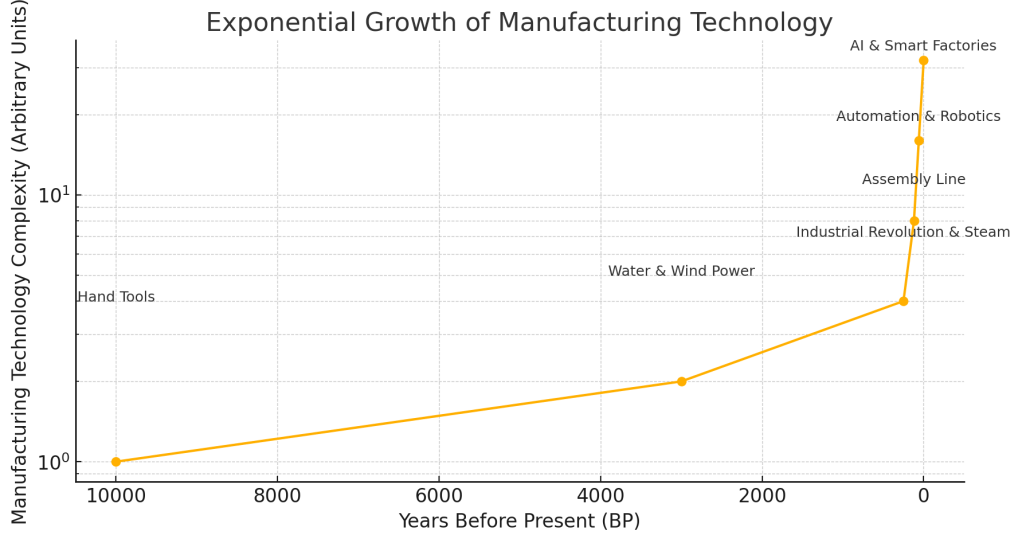
    We can see this same exponential growth if we divide technology into certain industries. Here are some charts below showing different technologies and their development.

    Figure 4: Showing the development of transportation technology. 

    Figure 5: Showing the development of communication technology.

    Figure 6: Showing growth of medical technology over time.

    Figure 7: Showing development of manufacturing technology over time. 

    Figure 8: Showing the development of energy technology over time.

    All these charts show the rough progression of technology over time. In the aim of transparency, all these charts were generated by ChatGPT. So they may not be perfect. But they do represent the general trend of technological acceleration. 

    I’m not deterministic, I do not think the acceleration of technology is an immutable law. There are no immutable laws when it comes to humans. But the drive for innovation has always been with us, long before Capitalism. And the acceleration of technological change was there long before Capitalism. 

    Those proponents of Capitalism who state that it is the cause for the acceleration of technology are making a basic mistake. They saw two corresponding trends occurring within a limited time frame, and – without any real evidence – they assumed one caused the other.  

    My argument is that this technological acceleration was already happening, and it was going to happen in some form or the other. What Capitalism did was to take control of this process, and ensure that the real benefits and wealth went to those at the top. 

    It is important to remember, you couldn’t make a Tesla unless some unknown and forgotten person (or maybe a group of people) invented the wheel about 6000 years ago. Or if a long line of people hadn’t figured out how to control fire and concentrate it in blast furnaces to work metal. All that occurred well before Capitalism. 

    The real driver behind this technological acceleration is humanity, with our inventiveness and our compulsion to make things better. We need to unshackle this drive from the control of Capitalists, and use it to build a better future for all. 

    In the second part of this essay, I’ll look at the role of the public sector in the development of modern technologies and innovation. Coming soon!

  • Loneliness and Its Impact on Politics

    I was watching a video the other day discussing comedian Bill Burr’s comments on Elon Musk that got him banned from Twitter/X.The video, linked below, started as something humorous but turned into a serious discussion on a topic that deeply impacts many of us.

    You can check out the video here.

    This issue is loneliness in our society. In the video it is discussed as a male loneliness epidemic. The commenter in the video brought up the many different studies that show a link between right-wing ideology and loneliness in all ages and genders, not just in young men. And there are a great deal of these studies that show this link such as this one.

    So in reality, loneliness is an issue for everyone in our society. It’s not just men. A recent Surgeon General’s report titled Our Epidemic of Loneliness and Isolation discusses how our communities are fraying and social connections are becoming weaker.

    This isn’t just due to modern society. Loneliness is a specific feature of our current economic system. A long-standing critique of capitalism is that it is alienating and causes the “atomization of the individual”. In short, this critique describes exactly what the Surgeon General’s report says is happening right now in the US.

    And as the multiple studies referenced above show, this loneliness manifests in our politics as far right ideology. We can’t fight loneliness. We can’t out argue it. We can’t protest it. The only way to counter it is through compassion. By building a new system where loneliness is not a key feature of it.

    The world around us is uncaring and selfish. So we need to be empathetic and selfless. The only way to counter all this is to be the counter argument ourselves. That is the only way that we win the game.

    Here is a good read on the atomization of the individual:

    All the Lonely People: The Atomized Generation

  • Why Tariffs Hit Regular People Harder

    Tariffs are once again in the news because President Trump recently implemented them against a number of our trading partners. The argument behind tariffs are that while they may raise consumer prices in the short-term, they will result in more manufacturing jobs in the long-term.

    In reality they are a form of regressive tax which means they hit poorer people harder than they do wealthy people. This is because tariffs are a tax that is most often passed on to the end consumer. Me and you.

    Prices for basic goods will go up, meaning all the things we need to live our daily lives will cost more. Think about how this will impact people on a fixed income such as elderly retirees. Or how it will affect a single parent raising a child. Or someone just trying to work their way out of poverty. 

    Wealthy people, on the other hand, can absorb these costs better because they are less of a share of their overall income. But for the rest of us, a 10% or 25% increase in basic goods will hit our wallets very hard. 

    Add to this regressive tax the Republican budget that is being debated that extends Trump’s tax cuts from his first term. These tax cuts heavily favor the rich. Both of these factors, the tariffs and the tax cuts, represent a redistribution of wealth upward.

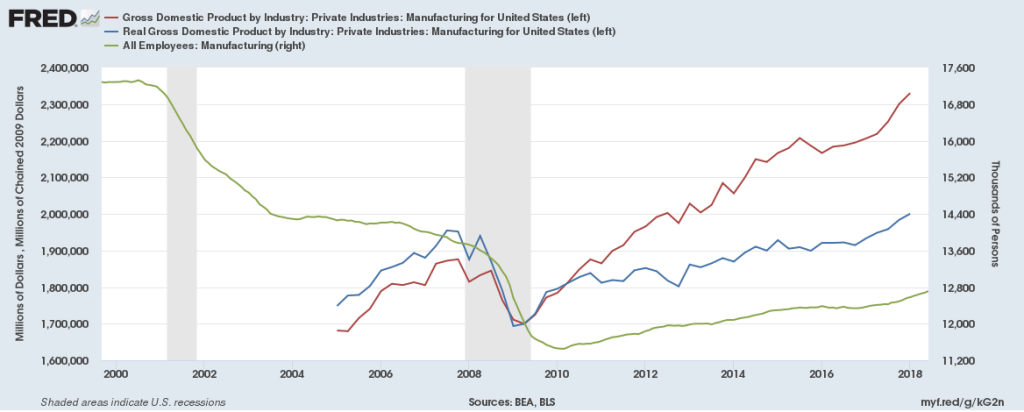
    In regards to tariffs bringing back domestic production, manufacturing output in the United States actually hit an all time high in 2023. The issue is that automation and now artificial intelligence has shrunk the number of workers needed in the production process. Looking at the chart below, it is easy to see the decline in manufacturing jobs in juxtaposition to a steady increase in manufacturing.

    Figure 1: Chart showing the decline of manufacturing employment (red), the increase of manufacturing as gross domestic product (green), and as real gross domestic product (blue).

    So, the idea of a manufacturing renaissance in America that rebuilds the middle class is a good narrative to sell, but only if you don’t factor in automation and AI. In reality, this is just another shift of wealth upward.

    Sources:

    Figure 1

    From Wikipedia, ultimate source is Federal Reserve Economic Data 

  • Wealth Inequality in the US

    One of the primary issues affecting our society right now is the unequal distribution of wealth. As the saying goes, the rich get richer and the poor get poorer. But in the past 30-35 years, this gap between the ultra wealthy and the rest of us has gotten increasingly wider.

    This is a topic that doesn’t get discussed very often in the mainstream media, and there is a lack of knowledge and understanding about it. So let’s look at a few charts that will help us get a sense of just how much wealth inequality has grown in the US and why.

    Figure 1: Showing the distribution of wealth among different income percentiles in 2024.

    The first chart shows the percent of ownership of wealth in the US by different economic brackets. The top 0.1% own 13.5% of total wealth in the US. Those people in the 99 to 99.9 % bracket own 16.7% of total wealth. Then those in the top 90 to 99% bracket own 35.5% of the total wealth.

    This means that the top 10 percent of wealthy people in this country own 65.7 percent of all the wealth. Meanwhile, 66,551,860 million Americans in the bottom 50% hold only 2.5% of wealth.

    It hasn’t always been this way, though. During the Postwar Era into the 1970s, there was a sort of shared prosperity in the United States, but this began to unravel during the trickle-down era of Presidents Reagan and George H.W. Bush.

    In Figure 2, shown below, we can see the growth in the share of national wealth owned by the different economic brackets. From 1989 onward, the share of wealth owned by the bottom 50% of Americans has not really grown, remaining relatively flat. But for the top 50% and above, especially the ultra-rich, their share of wealth in this country has exploded. 

    Figure 2: Showing the change in wealth ownership per percentile from 1989 to 2020.

    Looking further back, we can see some factors that helped this wealth inequality to take off in the late 1980s and early 1990s. 

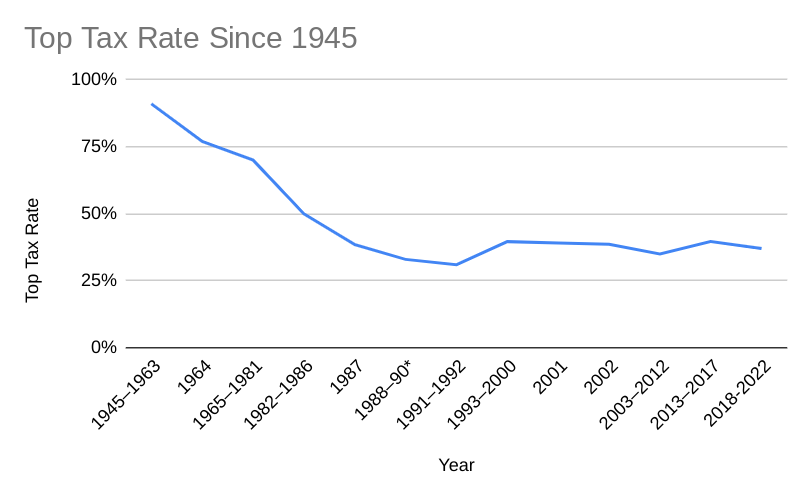
    Figure 3: Showing the tax rate for the top income bracket in the US tax code, from 1945 to 2022.

    According to Figure 3, the tax rate for the top income bracket in the United States started dropping from the wartime high of over 90% in the postwar period through the 1970s. Beginning in 1982 and lasting through the early 1990s, however, taxes on the top income bracket were cut significantly. In 2022, the average tax rate for top earners was actually around 23 percent. This is quite a change from the post war period.

    This reduction of the top tax rate was done according to the trickle-down theory of economics where if the rich could keep their money, they would invest it in ways that helped the overall economy and regular people. But this is not how rich people operate, and it is not what has happened at all. They have invested it in luxury goods, property, and in controlling the political process.

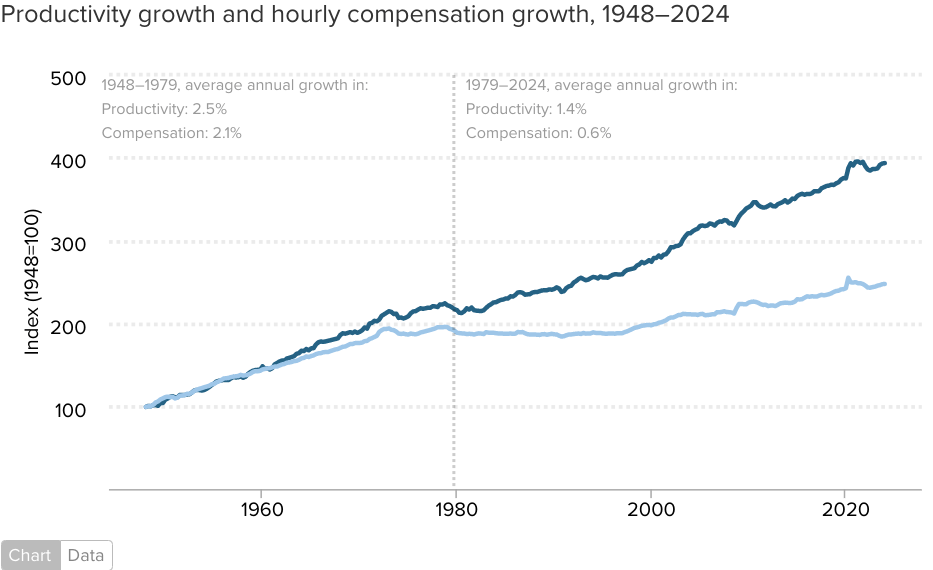
    Figure 4: Showing Productivity Growth versus hourly compensation growth from 1948 to 2024.

    In this figure, the relationship between productivity and wages is examined. Between 1948 and 1979, the growth in productivity and wage increases were relatively the same. But between 1980 and the present, they have become unbalanced, with the average yearly wage increase being only 0.6% per year after 1980, compared to 2.1% per year before.

    In short, those who own the workplace have gotten more production from American workers and have had to pay less wages for it. That difference in money has to go somewhere, and it has gone to the top.

    Figure 5: Showing the growth in real wages, as adjusted for inflation, from 1979 to 2013. 

    This next chart shows the growth in wages with inflation factored in. The bottom 10 percent of wage earners in the US have actually seen a decrease in their wages versus the rise in inflation. Even middle wage earners, those in the 50th percentile have only seen modest growth in the actual purchasing power of their wages.

    All of these factors have combined to create the enormous wealth inequality that we see in society today. Cutting the tax rate for the most wealthy resulted in more of the money in society going to the top. The growth in productivity and increase in inflation also helps to shift wealth to the top. This is especially true in relation to wage increases being mostly stagnant over the last 30 years or so.

    All this money has gone to the top of our society, it has allowed the wealthy to invest that extra money in ways that make regular people’s lives harder. I will be exploring why this inequality is unhealthy and unstable for society in future blogs.

    Sources for Figures

    Figure 1: U.S. wealth distribution Q2 2024. Published by Statista Research Department, Oct 29, 2024. https://www.statista.com/statistics/203961/wealth-distribution-for-the-us/

    Figure 2: Federal Reserve data. https://www.reddit.com/r/economy/comments/1cj69xf/top_10_of_americans_own_70_of_the_nations_wealth/#lightbox

    Figure 3: Historical Income Tax Rates. https://www.wolterskluwer.com/en/expert-insights/whole-ball-of-tax-historical-income-tax-rates

    Figure 4: Wage Stagnation in Nine Charts https://www.epi.org/publication/charting-wage-stagnation/

    Figure 5: Wage Stagnation in Nine Charts https://www.epi.org/publication/charting-wage-stagnation/

  • The Upcoming Consumer Boycott

    Tomorrow (Feb. 28) there is a call for a national consumer boycott to show displeasure with the alignment between the Trump Administration, billionaires such as Elon Musk, and large corporations. This is a great first step in pushing back on these forces.

    But it is an initiative that needs to be sustained. And it needs to be much deeper and broader than a consumer boycott. We need a larger shift. We need to exit the system.

    We can do that by using our purchasing power at local stores, cooperative businesses, and non-corporate stores as best we can. We can bank at credit unions instead of megabanks. We can establish mutual aid societies to help each other through difficult times. The more money we shift in these directions, the more these enterprises can flourish and diversify.

    The impacts of buying local are much larger than just the economic benefits and independence it brings. It makes our communities more resilient in the face of catastrophe or pandemics. This is especially true when it comes to our food sector. We need to be gardening, supporting local farms, canning, and taking care of our neighbors like people did back in the day. 

    This helps to lessen the effects of having a centralized food market. In the case of a catastrophic event or pandemic when supply lines could possibly be severed, local food systems and economies will be extremely important. It is better to have them built now than in the middle or aftermath of a pandemic.

    It’s important to remember, the most valuable thing about us isn’t our money, it’s our time and energy. Our communities are frayed, our social connections are frayed, and in general there is not a lot of trust in our society. Getting out and helping to build up your community is one way to re-establish the connection and trust that people used to have. We need to work with each other to build back up and heal our communities.

    Sometimes the best resistance is simply walking away and building something better. This is one of those times.

  • A Way Out of this Mess

    For those of us who are not part of the MAGA movement, the past month or so since Trump took office has been one shocking development after another. Whole agencies such as US AID are being dismantled. Somehow the richest man in the world is in direct control of our government. Our international relations are in a state of upheaval. It goes on and on.

    This is all part of the plan to reshape our society, and the onslaught of decisions and headlines that the Trump Whitehouse is creating is an example of what is called Shock Doctrine. Naomi Klein has written a rich and thorough history of its use through the 20th and 21st centuries. So I won’t go into it right now. But what is important is that Shock Doctrine tactics are a weapon being used in a much larger attack.

    This attack is coming from the billionaire class, and I would call it a class war but really only one side is actually fighting. So maybe we should call it a class offensive.

    In simple terms, the rich are in competition with us for pretty much everything. Especially now with extreme wealth being amassed at the top of society. They use this wealth to compete with us in the political sphere to control politicians. They compete with us in the housing market by buying up properties for rent. They compete with us in getting their kids into prestigious educational institutions and careers. They increasingly compete with us more and more in all spheres of our lives due to the extreme wealth they are able to invest.

    This class offensive has always been present in our society, but it was always in the background. But now it is open, and it is brazen. They are not hiding their punches, they are just swinging haymakers in hopes of a knockout win.

    But there is no real pushback from those of us on the receiving end of this class offensive. And I have a hard truth about that potential pushback. It’s too late. The billionaires have already won. They have control, and their ultimate goals are far darker than what many people realize. This is their game, they own the ball, the referees, and the court.

    If we play their game, we lose. If we fight within the system, we lose. The only way to win is to play a completely different game. The way out of this mess is to build a new system that puts humans at the center, rather than wealth.

    An economy structured around cooperative businesses, mutual aid, and community wealth would be vastly superior to our current one. And this is a very achievable goal, there are working examples around the world which I will discuss in future blogs.

    This new society will need teachers, scientists, engineers, researchers, doctors, carpenters, plumbers, and even bankers. But what it can’t have is billionaires and vast wealth inequality. Without us, what can the rich really do? If we don’t play their game, they lose.

    To make this happen it is going to take work. It is going to take time. We’re all going to have to get involved with each other, work with each other, and build the future we want together. I’m not saying give up politics completely, but at this point it should be seen as a rearguard action as we transition into something new.

    It may seem a bold and radical solution. But I think all of us know deep down that we need something new. Something more human.