There is a persistent anxiety about the end of the world that hangs over our society. It appears in the news, in casual conversations, and across popular culture. Whether the catastrophe takes the form of environmental collapse, artificial intelligence, or nuclear war, many of the forces shaping our world seem to point in a single direction: toward some form of societal rupture or breakdown.
So it is not surprising that so many people feel this way. The sense that we may be living through a precarious moment, perhaps even an ending, is not irrational. It is a response to real conditions. This blog begins with that recognition. Its aim is not to dismiss these concerns, but to confront them, understand them, and ask whether there might be a path through them.
I understand that this is not a pleasant topic to think about. Its not a fun topic for me to write about and contemplate. The reason I directly confront it, however, stems from my work as a carpenter. On a construction project, we run into issues all the time. Some of them are problems that would be easier to avoid, but if we did it would just cause us problems later on in the project. So we have to confront them and figure out a solution.
I feel the same way about what I call “apocalyptic anxiety”, the sense of impending doom that many of us have today. Let’s address it, understand it, and figure out a way forward.
For me, the answer is not an easy one, and it does not depend on any sudden supernatural intervention. Instead, the work is grounded in ordinary life. It begins with the development of our inner selves, what I will describe in this project as a kind of “critical spirituality.” From there, it extends outward into how we act, how we relate to others, and how we structure the world around us.
This is not easy work. It requires effort, reflection, and often a willingness to step outside our comfort zones. It asks us to examine our assumptions, our habits, and our responsibilities to one another. It also demands a broader transformation, social as well as individual, if we are to navigate the risks of the present moment.
There is no simple program here, and no quick solution. But there is a direction. And we have a chance to see more clearly what kind of future we need to build, and what kind of people we need to become to sustain it.
That is the purpose of this blog.
To think through the crisis of our time, and to begin, however imperfectly, the work of building something better…together. ____________________________________________
This essay develops themes explored more fully in my recently published book, The Last Apocalypse: Consciousness, Revelation, and the Future of Humanity.
Warfare has always been shaped by technological innovation. From metallurgy and explosives to aviation, computing, and satellite navigation, militaries have consistently sought new technologies that provide an advantage on the battlefield. Today, another transformation is underway. The rapid development of unmanned aerial vehicles (UAVs), ground and naval drones, and the emergence of artificial intelligence are changing not only how wars are fought, but also who fights them, where they are fought, and how decisions about life and death may ultimately be made.
The war between Russia and Ukraine has become the world’s largest testing ground for many of these technologies, offering a glimpse into what future conflicts may look like. While drone warfare has the potential to reduce the exposure of soldiers to direct combat, it also expands the battlefield, lowers the cost of projecting military power, and raises difficult ethical questions about increasingly remote and autonomous warfare. These are developments that deserve careful attention, because their implications extend well beyond the current conflict.
The Drone Revolution
The development of military drones is not a recent phenomenon. During World War II, the United States experimented with radio-controlled aircraft, and in the early 1950s the U.S. Air Force introduced the Ryan Firebee, a jet-powered drone primarily used as an aerial target. As the Cold War intensified, surveillance became a major focus, leading to the development of unmanned aircraft capable of gathering intelligence while reducing the risks faced by pilots. During the Vietnam War, these systems expanded beyond reconnaissance to include electronic warfare, leaflet distribution, and decoy missions designed to expose enemy air defenses.
The modern era of drone warfare began in the 1990s with the introduction of the General Atomics Predator. Unlike its predecessors, the Predator could not only observe the battlefield but also strike targets. During the Global War on Terror, drones became an increasingly important tool for surveillance and precision strikes against high-value targets, culminating in larger and more capable systems such as the MQ-9 Reaper.
For much of this period, the United States emphasized highly sophisticated and extremely expensive drone platforms. More recently, however, another model has emerged. Rather than pursuing the most technologically advanced systems possible, countries such as Iran have focused on producing inexpensive drones that can be manufactured in large numbers. Even when individually limited in capability, these systems can force an adversary to expend air-defense missiles costing millions of dollars to destroy drones worth only tens of thousands. Ukraine has adopted a similar approach against Russia, and Taiwan is preparing for the possibility of doing the same in the event of a conflict with China. This shift is changing the economics of warfare by allowing relatively inexpensive systems to threaten far more costly military equipment.
Nowhere is this transformation more evident than in the war between Russia and Ukraine. The conflict has become an enormous laboratory for drone warfare, where innovations are tested, countered, and refined at a pace rarely seen in modern military history. First-person-view (FPV) drones have become ubiquitous, allowing operators to guide drones directly onto their targets. Unmanned ground vehicles now transport supplies, lay and clear mines, evacuate wounded soldiers, and even serve as remotely operated weapons platforms. Naval drones have likewise emerged as an increasingly important component of the conflict.
Perhaps most striking is the speed of innovation. Each side continually adapts to the other’s latest technology, driving new ideas from conception to the battlefield in a matter of months rather than years. This stands in sharp contrast to the traditional military procurement process, where developing, testing, and fielding new equipment often takes many years. The result is a battlefield where technological evolution occurs almost in real time.
The Changing Role of the Soldier
Perhaps the most profound consequence of drone warfare is that it is beginning to separate the soldier from the battlefield itself. Soldiers remain essential to modern warfare, and no current conflict has eliminated the need for infantry, armor, or artillery. Yet in Ukraine, drones are increasingly carrying out missions that would once have required soldiers to expose themselves directly to enemy fire.
In some sectors of the front, the density of drone surveillance and attack has created broad areas where movement by foot or vehicle is exceptionally dangerous. Both sides rely heavily on unmanned systems to cross these zones, delivering supplies, evacuating wounded personnel, conducting reconnaissance, or striking enemy positions. In some ways, these areas resemble the “No Man’s Land” of the First World War, where advancing soldiers faced overwhelming danger. The difference today is that increasingly it is robot that cross these deadly spaces instead of humans.
Some Ukrainian military leaders have even suggested that future frontlines may require dramatically fewer soldiers than they do today, with unmanned systems performing many of the most dangerous combat tasks. Occupying and securing territory will almost certainly continue to require soldiers on the ground, but the direct delivery of firepower may increasingly come from operators located miles from the battlefield.
For thousands of years, the soldier has been the central figure of warfare, whether armed with a spear, sword, bow, rifle, or tank. Drone warfare represents one of the first genuine departures from that tradition. The person delivering lethal force is no longer necessarily standing on the battlefield. Instead, they may be sitting in a command post many miles away, viewing the conflict through a screen. What this shift will ultimately mean for military strategy, for the psychology of combat, and for society’s understanding of war remains an open question.
The Expanding Battlefield
If drone warfare has the potential to remove soldiers from parts of the battlefield, it also has the potential to expand the battlefield itself. One of the defining characteristics of the war in Ukraine has been the increasing importance of factories, power grids, transportation networks, communication systems, and other infrastructure that sustain military production. As both Russia and Ukraine have sought to degrade each other’s ability to produce drones, ammunition, and other military equipment, these systems have become increasingly important strategic targets.
This reflects a broader shift in the nature of warfare. Success is no longer determined solely by which army can outmaneuver the other on the battlefield, but also by which nation can sustain industrial production, adapt its technology, and replace its losses more quickly. In many respects, war is becoming as much a contest of manufacturing capacity, engineering, logistics, and supply chains as it is of soldiers and weapons.
The economics of drone warfare reinforce this trend. A drone costing only a few thousand dollars may require an interceptor missile costing hundreds of thousands or even millions of dollars to destroy. This imbalance creates enormous incentives to develop cheaper methods of defense while simultaneously increasing the importance of maintaining the factories, energy systems, and transportation networks that make large-scale drone production possible.
The result is a troubling paradox. As technology removes more soldiers from direct combat, it also broadens the range of places that become strategically significant during war. The battlefield no longer ends at the front lines; it increasingly extends into the industrial and civilian systems that support the war effort.
The Future of Warfare
If the war in Ukraine demonstrates anything, it is that innovation in warfare is no longer measured in decades but in months. Each technological advance is quickly met with a countermeasure, which is then answered with another innovation. The result is a battlefield where adaptation has become as important as the technology itself.
Many of these developments are already changing the balance of military power. Relatively inexpensive drones now allow smaller nations and even non-state actors such as terrorist organizations and criminal cartels to field capabilities that were once reserved for the world’s largest militaries. Precision strike capability is becoming increasingly affordable, lowering the barriers to projecting military force.
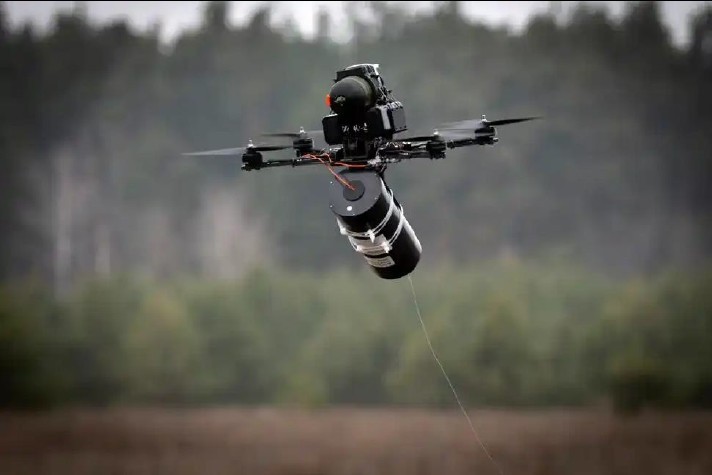
The pace of innovation shows no sign of slowing. Naval drones are beginning to transform maritime warfare, while fiber-optic-guided drones have emerged as a response to electronic jamming, trailing cables across fields and villages as they remain physically connected to their operators. New tactics and technologies appear on the battlefield almost as quickly as they can be conceived.
One reason for this rapid evolution is that militaries are increasingly encouraging innovation from the bottom up. Rather than waiting years for formal procurement programs to produce new equipment, the US military is starting to adapt commercially available drones to meet immediate battlefield needs. Throughout history, soldiers have demonstrated remarkable ingenuity in solving tactical problems, and inexpensive drone technology has dramatically expanded what small units can accomplish with limited resources.
The next stage of this evolution may prove even more consequential. Artificial intelligence is already being incorporated into drone systems to assist with navigation, target recognition, and autonomous operation. Swarms of coordinated drones acting together could overwhelm traditional defenses, while increasingly autonomous systems may reduce the amount of direct human control required to carry out attacks.
Conclusion
While researching this essay, I watched a documentary about a Ukrainian drone unit responsible for striking Russian soldiers and military vehicles. The operators were young, many in their twenties, a generation that had grown up playing video games. Sitting behind computer screens, they guided drones toward targets miles away from their position. Their mission was understandable in that they were defending their homeland and fighting to reclaim occupied cities.
Yet the technology itself raises unsettling questions. The physical distance created by drone warfare also creates psychological distance. Throughout history, soldiers have generally confronted the terrible reality of violence face to face. Drone operators experience war differently. Watching a battlefield through a screen inevitably changes the experience of combat, and it may also change our relationship to killing itself.
This concern is reinforced by aspects of drone culture that have emerged during the war. First-person-view footage is regularly shared on social media, while some military units have experimented with reward systems resembling the “kill streaks” and point systems familiar to many video games. These developments do not erase the reality that war remains horrific, but they do illustrate how technology can blur the boundary between genuine combat and virtual experience.
Drone warfare presents a striking paradox. It has the potential to make war safer for soldiers by removing them from some of the most dangerous parts of the battlefield. At the same time, it expands the battlefield into factories, power grids, transportation networks, and civilian infrastructure. It makes entire societies more directly involved in sustaining the war effort. War becomes increasingly remote for those fighting it, while becoming increasingly immediate for everyone else.
Looking ahead, the questions become even more profound. As artificial intelligence becomes integrated into drone systems, humans may increasingly surrender not only the act of fighting but also parts of the decision-making process itself. At what point does assistance become autonomy? At what point do we become comfortable allowing machines to determine when and how deadly force should be used?
Drone warfare is unlikely to disappear. If anything, it represents the beginning of a much broader transformation in the nature of war. More fundamentally, it illustrates a pattern that extends well beyond the battlefield: our technological capabilities are advancing more rapidly than our moral and ethical frameworks. We are developing increasingly sophisticated systems capable of finding, tracking, and killing human beings while only beginning to confront the ethical questions they raise. Whether humanity can develop the wisdom to govern these technologies may prove to be one of the defining challenges of the twenty-first century.
Cover image is of a fiber optic spool-fed drone from the US Army. Source image found here.
This is part 1 of a four-part series that deals with the rapid development in the technology of war and its implications for humanity. You can read the other essays from the links below:
Part 2: The Weaponization of AI
Part 3: What Does Autonomous Warfare Look Like?
Part 4: The Last Arms Race: Teaching AI to Wage War
This essay develops themes explored more fully in my recently published book, The Last Apocalypse: Consciousness, Revelation, and the Future of Humanity.
The Kingdom of God is one of the central ideas in the teachings of Jesus, yet it is also one of the most misunderstood. Today, many people equate it with heaven or the afterlife. But that is not what ancient Jews generally had in mind, nor is it exactly what Jesus was talking about. To understand how he conceived of the Kingdom of God, we first have to understand the world in which he lived. In this essay, we’ll explore what the Kingdom of God meant in Second Temple Judaism, how Jesus built upon and reinterpreted that tradition, and why I believe his vision still has profound relevance for the challenges facing our society today.
What Ancient Jews Meant by the Kingdom of God
When ancient Jews spoke about the Kingdom of God, they were generally not referring to Heaven. They envisioned God intervening in human history to establish his rule on Earth. This kingdom would center on the restoration of Israel, the defeat of evil, and the renewal of creation.
Much of this expectation was rooted in God’s covenant with David as described in 2 Samuel 7. According to the biblical account, David united the kingdoms of Israel and Judah into a single monarchy. God then promises that a descendant from David’s line will forever rule over his people.
Most archaeologists today believe that there really was a historical David who lived around the tenth century BCE. This is supported in part by the Tel Dan Stele’s reference to the “House of David.” However, many scholars doubt that his kingdom resembled the vast united monarchy described in the Bible. Instead, it was likely a much smaller highland kingdom whose size and influence were expanded by later biblical traditions.
Over time, the Davidic covenant took on increasing importance. By the Second Temple period, hopes for a future heir from David’s line had become widespread. Judea had spent centuries under foreign domination by first Babylon, then Persia, followed by Greece, and finally Rome. Many Jews believed that God would soon intervene in history, overthrow these foreign powers, restore the line of David, and reunite Israel under a righteous king.
For many Jews of this period, this restoration of the Davidic kingdom was one of the primary ways they envisioned the coming Kingdom of God. The expected Messiah would rule as God’s anointed representative. The word Messiah simply means “anointed one,” referring to the ancient practice of anointing Israelite kings with oil as a sign that they had been chosen by God. Jerusalem would once again become God’s holy city, Israel would be restored, and the nations would recognize God’s rule.
This kingdom would be a true theocracy, with God as the ultimate king and the Messiah governing as God’s representative. Justice would replace corruption and oppression. The wicked would be judged, God’s law would be faithfully observed, and peace would replace violence.
The coming of God’s kingdom also involved a cosmic renewal. The dead would be raised, the righteous vindicated, and a final judgment would take place. Evil and those forces opposed to God would be defeated, then Creation itself would be renewed. Images such as the Tree of Life, abundant fertility, and harmony within nature recalled the Garden of Eden and pointed toward the restoration of God’s original intention for creation. The prophet Isaiah envisioned a world where nations “shall beat their swords into plowshares,” symbolizing an age of lasting peace.
Although centered in Israel, this kingdom ultimately had universal significance. God’s reign would extend beyond Israel to all nations, and all creation would acknowledge his sovereignty. For many Jews, this was not simply another era of history but the beginning of God’s final and enduring reign over a restored world.
Jesus and the Kingdom
Jesus’ message was deeply rooted in these Jewish expectations of the Kingdom. He did not invent an entirely new concept. Rather, he inherited the hopes of Second Temple Judaism: a Davidic Messiah, the resurrection of the dead, a final judgment, the restoration of Israel and the Twelve Tribes, and God’s reign over the Earth. Matthew 19:28 illustrates this continuity well. Speaking to his disciples, Jesus says:
“You who have followed me will also sit on twelve thrones, judging the twelve tribes of Israel.”
This saying makes little sense outside the framework of Jewish restoration theology. Jesus expected God’s kingdom to be established, and his disciples would play a central role in that restored Israel.
Where Jesus differs is not so much in what he expected as in how he understood the Kingdom to begin. While many of his contemporaries looked almost exclusively to God’s future intervention, Jesus proclaimed that the Kingdom was already beginning to break into the world through his ministry. The coming reign of God might still be in the future, but its first signs could already be seen.
Jesus also placed remarkable emphasis on the people who would inherit the Kingdom. He repeatedly reverses normal social expectations. The Kingdom belongs not to the wealthy and powerful but to the poor, the meek, children, sinners, and outsiders. This concern for the marginalized has deep roots in the Hebrew prophets, but Jesus places it at the very center of his message.
Most importantly, Jesus understood the Kingdom as something recognized through action and transformed lives. He calls his followers to love their enemies, forgive others, serve rather than dominate, feed the hungry, care for the poor, welcome children, and visit those in prison. Matthew 25 is perhaps the clearest example, where entrance into the Kingdom is connected not to correct belief alone but to concrete acts of compassion: feeding the hungry, clothing the naked, welcoming the stranger, and caring for those in need.
Although Jesus’ mission began with Israel, there are strong indications that he envisioned God’s Kingdom ultimately extending beyond ethnic Israel. Stories such as the Good Samaritan, the faith of the Roman centurion, and the image of people coming from every direction to join the heavenly banquet all point toward a kingdom whose boundaries are far wider than many of his contemporaries expected.
Finally, Jesus emphasizes an inner transformation alongside the outward renewal of the world. Mercy, purity of heart, forgiveness, humility, and love are not merely private virtues. They are the qualities that characterize citizens of God’s Kingdom. The Kingdom, therefore, is not simply a future political order established by divine intervention. It also begins wherever people embody the values of that coming world in the present.
Why This Matters Today
Whether or not one shares Jesus’ expectation of an imminent divine intervention, his vision of the Kingdom remains remarkably relevant. The values that Jesus associated with God’s Kingdom are timeless. These include compassion instead of domination, justice instead of exploitation, forgiveness instead of vengeance, and service instead of the pursuit of power.
Many of the problems confronting our modern world stem from our failure to embody these principles. We are living through an age of increasing loneliness, political polarization, economic inequality, environmental degradation, and rapidly advancing technology. Artificial intelligence, in particular, forces us to ask what kind of civilization we are becoming. As I have argued in a previous essay, the systems we build will inevitably reflect the values of the society that creates them.
Jesus also understood that lasting change begins with transformed people. A healthier society cannot simply be legislated into existence. It must be built by individuals and communities committed to compassion, justice, mercy, and forgiveness. These are not merely private virtues. They are the foundation of healthy institutions and, ultimately, of civilization itself.
This is why I believe that the teachings of Jesus remain deeply relevant to the challenges posed by artificial intelligence. As we increasingly entrust decisions to technological systems, the moral character of the society designing those systems becomes ever more important. A civilization driven primarily by greed, fear, and domination will build technologies that reflect those priorities. One rooted in compassion, wisdom, and justice is far more likely to create technologies that support the flourishing of humanity.
Jesus also taught that the Kingdom was measured by how a society treated its most vulnerable members. The poor, children, prisoners, the sick, widows, and strangers were not peripheral to his message; they stood at its center. Including the marginalized, lifting up the poor, and helping people rebuild their lives does more than alleviate suffering. It strengthens the moral fabric of our society. A community that surrounds its children with healthy relationships, meaningful opportunities, and genuine care is preparing the next generation to lead wisely. In that sense, building the Kingdom is not only about helping people today. It is also about shaping the future.
Perhaps this is the deepest lesson we can take from Jesus. The Kingdom of God is not merely something to wait for. It is something to begin building. Every act of compassion, every effort to heal injustice, every community strengthened, and every life restored becomes a small budding of the world Jesus hoped was coming.
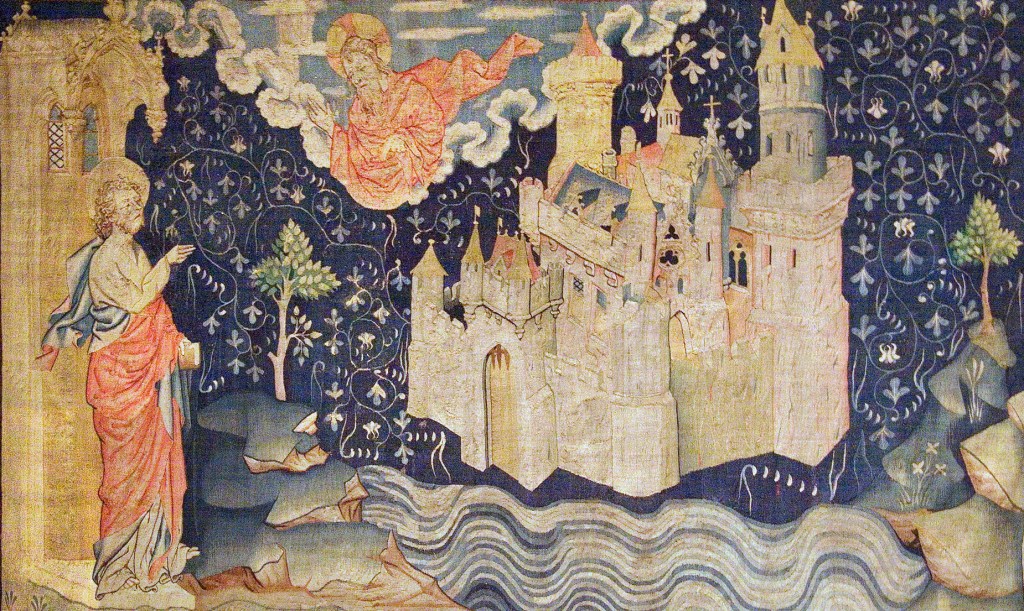
Cover image is The Apocalypse Tapestry, 1373–1382. By Bondol, Jean (designer), and Nicolas Bataille (weaver). Château d’Angers, Angers, France. Source image found here.
This essay is part 4 of a four-part series that deals with apocalyptic thought and its influence on modern society. You can read the other essays from the links below:
This essay develops themes explored more fully in my recently published book, The Last Apocalypse: Consciousness, Revelation, and the Future of Humanity.
If you have spent any time in or around modern Christianity, especially in the United States, you have probably heard of the Rapture. According to this belief, Christians will suddenly be taken by Jesus from the Earth and carried up to Heaven. For most people who hold to Rapture theology, this event will occur before a period of tribulation and, ultimately, the end of the world. While this idea is extremely popular among many evangelical Christians today, it is a relatively modern doctrine. And as we will see in this essay, the Rapture, as it is commonly understood, is not actually taught in the Bible.
To explore this claim, we need to go back to the world in which Jesus lived and taught. We discussed the apocalyptic worldview of Second Temple Judaism in the first essay in this series and the historical Jesus in the second. As a quick refresher, apocalypticism was centered on a genre of literature and storytelling in which a human narrator is taken up to heaven or receives a vision. Then usually an angelic being reveals the secrets of heaven and God’s plan for humanity to the narrator. These revelations often included a cosmic struggle between good and evil, the destruction of the current corrupt world order, and the establishment of God’s Kingdom on Earth.
While there were many variations within this worldview, one of the most popular themes was the restoration of the Davidic kingdom through a messiah from the line of David who would rule Judea as God’s representative on a renewed Earth. Another important feature was the expectation of a general resurrection of the dead. In this vision of the future, the righteous would remain and inherit God’s Kingdom, while the unrighteous would be destroyed. This did not involve eternal torture. Rather, many Jews of this period appear to have held what we would today call an annihilationist view, in which the unrighteous are consumed by fire and cease to exist.
When we look at Jesus, we see him speaking directly within this framework, in a way that was very much in line with Jewish apocalyptic expectations of the day. For him the Kingdom of God was imminent, and he and his disciples had a definite role in it. This would take place on Earth, rather than Heaven.
But once Jesus was executed, this changed everything. With his death and ascension, Jesus is not on Earth to fulfill the role of the Messiah, he is in Heaven. So he has to come back. This is where the idea for the Second Coming originates, and it is from this impending event that Rapture theology is based.
With this background, we can evaluate whether the modern doctrine of the Rapture is actually found in the New Testament.
1 Thessalonians 4 and the Meaning of Apantēsis
One of the key passages used to support the doctrine of the Rapture is 1 Thessalonians 4:13-18. In this passage, Paul describes what he believes will happen when Jesus returns. He writes that believers will be “caught up” to meet the Lord in the air. The Greek word translated as “caught up” is harpazō. When the New Testament was later translated into Latin, harpazō was rendered as rapiemur, from which the English word “rapture” ultimately derives.
Yet the most important phrase in the passage may not be “caught up” at all, but rather the verb “to meet.” The Greek word used here is apantēsis. Many scholars note that this was often used as a technical term to describe the custom of a city’s inhabitants going out to greet an arriving king, dignitary, or honored guest and then escorting that person back into the city.
We see this word elsewhere in the New Testament. In the parable of the ten virgins, people go out to meet the bridegroom. In Acts, believers travel out to meet Paul and accompany him on his journey. The image is not one of people leaving permanently for another destination. Instead, it is a picture of people going out to welcome a returning figure and then accompanying him as he arrives.
The same observation applies to the word “air.” The Greek word used is aēr, which refers to the lower atmosphere. Paul does not use the more common Greek word ouranos (”heaven”) in this passage. Likewise, the reference to “the clouds” (nephelais) is consistent with this event happening in the Earth’s atmosphere. In fact, there is no point in this passage where believers are taken away to heaven permanently.
The Days of Noah
Another passage often cited in support of the Rapture is Matthew 24:40-41, where Jesus says:
“Then shall two be in the field; the one shall be taken, and the other left. Two women shall be grinding at the mill; the one shall be taken, and the other left.”
At first glance, many readers assume that the person who is “taken” is one of those being taken up to Heaven. However, it is important to look at the verses immediately preceding this passage, because they provide the context for what Jesus is describing:
“But as the days of Noah were, so shall also the coming of the Son of man be. For as in the days that were before the flood they were eating and drinking, marrying and giving in marriage, until the day that Noah entered into the ark, And knew not until the flood came, and took them all away; so shall also the coming of the Son of man be.” (Matthew 24:37-39)
The crucial question is: Who was taken away in the story of Noah? It was not Noah and his family. They were the ones who remained. The people who were “taken away” were the unrighteous who perished in the flood. If Jesus is using the days of Noah as the model for understanding his return, then the passage points in the opposite direction from modern Rapture theology. The righteous remain, while the unrighteous are removed in judgment.
This interpretation becomes even stronger when we examine other parables Jesus uses to describe the coming Kingdom of God.
The Wheat and the Tares
We can see this same pattern in the Parable of the Wheat and the Weeds (or Tares), found in Matthew 13. In the parable, a farmer sows good seed in his field, but an enemy secretly plants weeds among the wheat. When the servants ask whether they should remove the weeds immediately, the farmer tells them to wait until the harvest. At that point, he says:
“Gather ye together first the tares, and bind them in bundles to burn them: but gather the wheat into my barn.”
This order is important. The weeds are removed first, while the wheat remains. If there were any doubt about the meaning of the parable, Jesus later explains it directly to his disciples. The field represents the world, the wheat represents the righteous, and the weeds represent the wicked. At the end of the age, Jesus says that the angels will first gather out of the Kingdom “all things that offend, and them which do iniquity.” Only after the wicked have been removed does “the righteous shine forth as the sun in the kingdom of their Father.”
Once again, the pattern is the same as in the story of Noah. The unrighteous are removed in judgment, while the righteous remain to inherit the Kingdom. This is the opposite of what we would expect if Jesus were teaching the idea of a Rapture in which believers are taken away from the Earth before judgment occurs.
Where Did the Rapture Concept Originate?
So where does the rapture idea come from? Surprisingly, it’s not ancient at all. It doesn’t appear in early Christianity. It doesn’t appear in medieval theology. Church fathers like Irenaeus and Augustine never describe anything like it.
Instead, the idea emerged in the early 1800s. It is most closely associated with John Nelson Darby, an Irish clergyman. In the 1830s, Darby began developing a new system of interpreting biblical prophecy, including the idea of a pre-tribulation rapture. These ideas are what came to be known as dispensationalism.
During Darby’s life, this particular theological framework was not very widespread. But that changed in 1909 with the publication of the Scofield Reference Bible, which popularized Darby’s ideas. They gained a wide audience through the 1910s and 1920s, especially in the United States.
From there, the idea spread further through books, preaching, and eventually popular culture. In the late 20th century, works like Hal Lindsey’s The Late Great Planet Earth (1970) and the Left Behind series (1995-2004) brought the Rapture into mainstream awareness. So, what many people today assume is a core Christian belief is, historically speaking, a relatively recent development. But it is a very popular concept in the US, especially among fundamentalist Christians across many Protestant denominations
Why This Matters
The reason the modern doctrine of the Rapture deserves careful critique is that it can shift attention away from the responsibilities we have in this world. It can diminish the urgency of Jesus’ message to begin living as if the Kingdom of God were already breaking into the world. At its heart, this is a choice between participating in the work of renewal here and now or expecting to be rescued from the world.
It is in what I believe to be Jesus’ authentic message that I find hope for our own age. Act now to help create the future we want. Take care of disadvantaged children now. Care for the elderly now. Stand beside those who have been harmed by unjust systems now. Lift up the people around you now. The Kingdom is not built through passive expectation but through the countless everyday choices that shape our communities.
Many scholars argue that Jesus, as an apocalyptic prophet, was a failed one. The end of the age he expected did not unfold in the way he anticipated. But perhaps the more important question is not whether Jesus failed but whether we did. He gave us a blueprint for a different kind of world with communities grounded in compassion, justice, forgiveness, and care for the vulnerable. Yet for much of the last two thousand years, many Christians have placed greater emphasis on waiting for Christ’s return than on embodying the Kingdom he proclaimed.
I consider myself a follower of Jesus rather than a Christian in the modern denominational sense. I see Jesus as someone uniquely attuned to what I call the universal consciousness, or the Elohim (see my book for an explanation). He looked at a world marked by injustice, corrupt power, and impending catastrophe. He interpreted those realities through the language of Second Temple Jewish apocalypticism.
But the lasting significance of his message is not found in the timetable of the end. It is found in his response which was to begin building the Kingdom now. It is within us, it is among us, and it is a task that belongs to every generation. If there is one lesson we should carry forward from Jesus’ apocalyptic message, it is this: don’t wait for a better world or to be rescued from this one. Start building the future you want now.
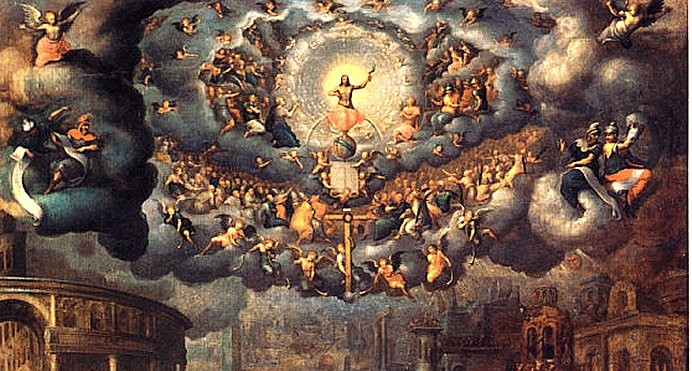
Cover image is The Last Judgement by Jean Cousin. Source image found here.
This essay is part 3 of a three-part series that deals with apocalyptic thought and its influence on modern society. You can read the other essays from the links below:
This essay develops themes explored more fully in my recently published book, The Last Apocalypse: Consciousness, Revelation, and the Future of Humanity.
In the previous essay, we explored ancient Jewish apocalypticism and saw that the concept of the apocalypse originally meant much more than simply the destruction of the world. It was a way of understanding history, one in which God would intervene, evil would be defeated, the dead would be raised, and a new age would emerge. In this essay we’re going to continue that discussion by looking at how the message of Jesus fits squarely in the framework of apocalypticism.
Who was the Historical Jesus
Specifically, we’re going to ask a question that has occupied scholars for more than a century: Who was the historical Jesus? This may sound like a strange question. After all, haven’t billions of people already answered it? Christians believe Jesus was the Son of God, the Messiah, and the savior of humanity. But historians ask a slightly different question. They want to know who Jesus was within his own historical context, before centuries of doctrine and theology accumulated around him.
To do that, we need to place Jesus back into the world in which he lived. He was not a modern American Christian. He was not a medieval Catholic. He was not a Protestant reformer. He was a first-century Jew living under Roman occupation during the Second Temple Period. And when we place him back into that world, a different picture begins to emerge.
The scholar most responsible for this shift was Albert Schweitzer. In 1906, he published a landmark study arguing that Jesus was best understood as an apocalyptic prophet. More than a century later, this remains the dominant view among New Testament scholars. While there is disagreement over some of the details, most scholars agree that Jesus proclaimed the imminent arrival of the Kingdom of God and believed that history was approaching a dramatic turning point.
That conclusion may surprise many modern Christians, because when people think of Jesus today, they often think of a moral teacher, a miracle worker, or a divine savior. But for Jesus and his earliest followers, the coming Kingdom of God was central to their belief. It was the lens through which they understood the world.
Reconstructing Jesus
Before we get to Jesus himself, however, we need to briefly discuss how historians know anything about him at all. Unlike many figures from antiquity, we actually possess a substantial amount of information about Jesus. We have the letters of Paul, written roughly twenty years after Jesus’ death. We have the four canonical gospels. We have the Book of Acts. And we even have a few references outside the Bible, most notably from the Jewish historian Josephus.
None of these sources are perfect, however. The gospels were not written as modern biographies. They are theological documents written by believers who were trying to persuade others of who they thought Jesus was. But historians work with imperfect sources all the time. The task is to compare these different traditions, identify points of agreement, and reconstruct what is most likely historical.
When we do that, a handful of facts emerge that are accepted by an overwhelming majority of scholars. Jesus was a real historical person. He was from Nazareth. He was baptized by John the Baptist. He carried out a ministry primarily in Galilee. He traveled to Jerusalem around Passover. And he was executed by the Romans through crucifixion. But the real question for us is not whether Jesus existed, it is instead ‘what was his message?’
John the Baptist and the Apocalyptic Movement
To answer this question, it helps to look at another important figure from Jesus’s time, John the Baptist, and Jesus’s relationship with him. John appears not only in the gospels but also in the writings of Josephus, giving us strong evidence that he was a real historical figure. His message was straightforward and urgent: repent, because the Kingdom of Heaven is near.
In Matthew’s gospel we read:
“In those days came John the Baptist, preaching in the wilderness of Judaea, and saying, Repent ye: for the kingdom of heaven is at hand.”
And in Luke’s version, John becomes even more dramatic:
“And now also the axe is laid unto the root of the trees: every tree therefore which bringeth not forth good fruit is hewn down, and cast into the fire.”
This is classic apocalyptic language. Judgment is coming and the old order is about to be overturned. But what is also noteworthy is John’s response when people ask him what they should do about the coming judgement, his answer isn’t complicated theology. He tells people to share what they have with those in need. If you have two coats, give one away. If you have food, share it.
In other words, apocalyptic expectation is immediately tied to ethical action. This pattern becomes central to Jesus’s message as well: the Kingdom is coming so we must change how we live.
The Original Gospel
Jesus’ public ministry begins immediately after John the Baptist’s. In fact, one of the strongest pieces of evidence that Jesus belonged to the broader apocalyptic movement is that he was baptized by John himself. This was probably an embarrassing fact for later Christians, because if Jesus was sinless and greater than John, why would he submit to John’s baptism? Yet the story appears in all four gospels. Historians often see this as a sign that it is likely authentic.
After John’s arrest, Jesus takes up the message and begins proclaiming it throughout Galilee. Mark, which most scholars believe was the earliest gospel, summarizes Jesus’ message in just a few lines:
“Now after that John was put in prison, Jesus came into Galilee, preaching the gospel of the kingdom of God, and saying, The time is fulfilled, and the kingdom of God is at hand: repent ye, and believe the gospel.”
This is a remarkable passage because it tells us what Jesus himself considered to be the “good news.” Notice that it is not yet about his death, resurrection, or salvation through faith. Those ideas would become central to later Christian theology. Here, the good news is that the Kingdom of God is arriving. The original gospel or good news was an announcement that a new age was breaking into history, that God’s reign was beginning, and the old world was passing away.
Luke’s gospel preserves a similar moment. Jesus stands in a synagogue and reads from the prophet Isaiah:
“The Spirit of the Lord is upon me, because he hath anointed me to preach the gospel to the poor… to heal the brokenhearted, to preach deliverance to the captives… to set at liberty them that are bruised.”
Again, the emphasis is not on escaping the world. It is on the arrival of God’s kingdom within the world.
This helps explain another aspect of Jesus’ ministry that often confuses modern readers: his miracles. Many people today see the miracles primarily as proof that Jesus was divine. But from an apocalyptic perspective, they served another purpose. They were signs that God’s kingdom was already beginning to break into the present age. When John sends messengers to see if Jesus is the Messiah, Jesus responds:
“Go and shew John again those things which ye do hear and see: the blind receive their sight, and the lame walk, the lepers are cleansed, and the deaf hear, the dead are raised up, and the poor have the gospel preached to them.”
In Luke 11, Jesus explicitly connects exorcisms to the Kingdom of God when he says:
“But if I cast out devils by the finger of God, no doubt the kingdom of God is come upon you.”
For Jesus, these acts were evidence that God’s power was already advancing against the forces of evil. Now, none of this means that Jesus was simply predicting the end of the world. In fact, one of the biggest misconceptions people have about apocalyptic prophets is that they are only interested in destruction. But as we discussed previously, apocalypse was fundamentally about transformation where the old world gives way to a new one.
Living the Kingdom Now
Jesus’s response to the coming Kingdom was simple: begin living according to the values of the Kingdom now. This answer appears throughout his teachings. Love your enemies. Bless those who curse you. Forgive others. Give to the poor. Do not retaliate. Treat others as you would want to be treated. Be merciful. Care for the vulnerable.
These teachings were not simply timeless moral principles floating in isolation. They were, in Jesus’ view, the way people prepared themselves for God’s coming kingdom. Or perhaps even more importantly, they were the way people began living in that kingdom now.
One of my favorite examples comes from the Lord’s Prayer. Many of us know the line:
“Thy kingdom come. Thy will be done in earth, as it is in heaven.”
Think about what that actually means. The prayer is not asking for escape to Heaven, instead it is committing to implementing God’s will here on Earth. The Kingdom of God is not merely a heavenly destination. It is a vision of a world reordered according to justice, compassion, and the will of God.
This also helps explain Jesus’ repeated warnings about wealth and power. Again and again, he criticizes systems of domination. He warns that one cannot serve both God and wealth, and he condemns religious leaders who seek status and prestige. He praises generosity. He elevates the poor, the widow, the outcast, and the marginalized.
In the story of being tempted in the wilderness, Jesus even rejects political domination itself when offered authority over the kingdoms of the world. His vision of the kingdom was not based on conquest, rather it was based on service. Not domination, but compassion. Not power over others, but responsibility toward them.
A Message for Our Time
This, I think, is where the historical Jesus still speaks powerfully to our own age. We live in apocalyptic times too. Our anxieties may center on artificial intelligence, climate change, nuclear weapons, pandemics, inequality, and political instability rather than Roman occupation. But the underlying question remains remarkably similar: How should we live during times of uncertainty and upheaval?
Jesus’ answer was not to withdraw from society. It was not to obsess over dates, predictions, or timelines. It was not to wait passively for rescue. His answer was to begin living the values of the coming kingdom now. We should care for the poor, lift up the vulnerable, love one’s enemies, and build communities grounded in compassion.
Whether or not Jesus was correct about the timing of God’s intervention, his prescription for navigating turbulent times remains profoundly relevant. As a carpenter myself, I can’t help but appreciate one of the parables attributed to Jesus about two builders.
“Therefore whosoever heareth these sayings of mine, and doeth them, I will liken him unto a wise man, which built his house upon a rock: and the rain descended, and the floods came, and the winds blew, and beat upon that house; and it fell not: for it was founded upon a rock. And every one that heareth these sayings of mine, and doeth them not, shall be likened unto a foolish man, which built his house upon the sand: and the rain descended, and the floods came, and the winds blew, and beat upon that house; and it fell: and great was the fall of it.”
We can see in this parable what was truly important for Jesus: for people to hear what he was saying and then act on that. For the historical Jesus, his focus was not on his death and resurrection. It was about hearing his message on the Kingdom’s ethics and putting it into practice.
What strikes me most is that Jesus’ response to apocalyptic anxiety was not fear. It was action. It was to live as though the Kingdom (or the future you hope for) is already beginning to emerge. Whether one is religious or not, that’s a powerful response to uncertainty.
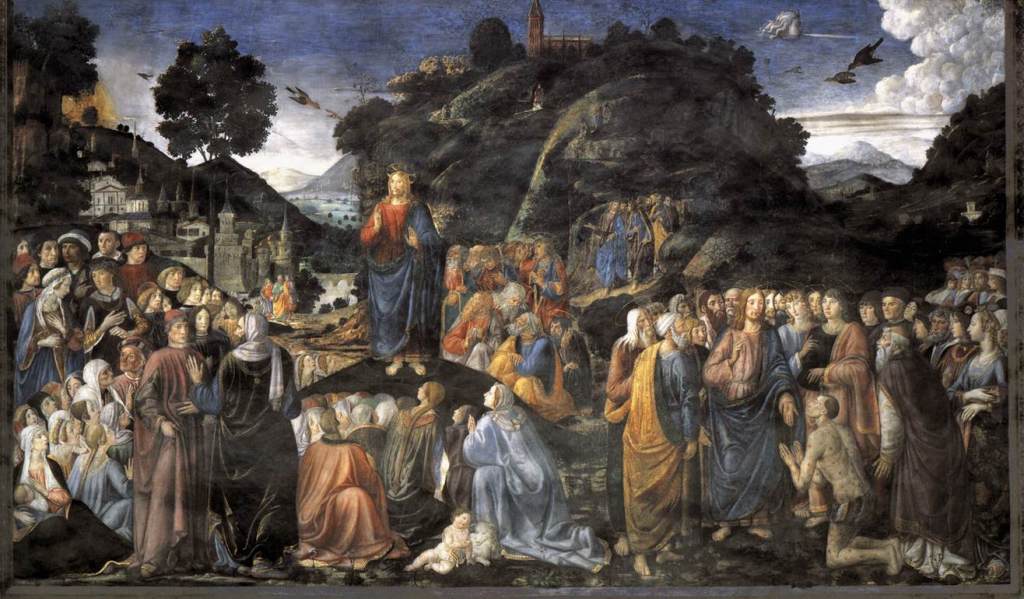
Cover image is Sermon on the Mount by Cosimo Rosselli, 1482. Source image found here.
This essay is part two of a three-part series that deals with apocalyptic thought and its influence on modern society. You can read the other essays from the links below:
This essay develops themes explored more fully in my recently published book, The Last Apocalypse: Consciousness, Revelation, and the Future of Humanity
In the past few essays, I’ve primarily focused on secular concerns: artificial intelligence, climate change, pandemics, political polarization, and war. In the next three essays, however, we will turn to the religious and spiritual roots of apocalyptic thinking by exploring ancient Jewish apocalypticism, the historical Jesus, and the modern doctrine of the Rapture.
Understanding these subjects is important because they continue to shape how millions of people think about the future. Ideas about the end times, divine judgment, the return of Christ, and the ultimate fate of humanity all emerged from this ancient worldview. Yet many modern assumptions about apocalypse differ dramatically from what ancient Jews and early Christians actually believed.
We have already discussed how the word apocalypse does not originally mean world-ending destruction. In its original sense, the Greek word apokalypsis means an unveiling or revelation. In other words a disclosure of hidden truths. This older meaning is essential not only for understanding ancient Jewish apocalypticism, but also for understanding the ministry of Jesus, which emerged directly from this worldview.
In this essay, I want to explore how ancient apocalyptic thought developed, what it meant to the people who embraced it, and what it might still have to teach us today. While ancient apocalyptic texts certainly contain visions of destruction and judgment, they are ultimately concerned with transformation. They ask how an upside-down world might be restored and what role human beings play within that process. That question remains just as relevant today.
The World That Produced Apocalypticism
To understand ancient Jewish apocalypticism, we first need a basic understanding of the historical world that produced it. Ancient Jewish history is often divided into two major periods: the First Temple Period and the Second Temple Period. The First Temple Period ended in 587 BCE when the Babylonians conquered Jerusalem, destroyed the Temple, and exiled much of the population. This exile became one of the defining moments in Jewish history. Removed from their homeland and surrounded by foreign cultures, Jewish communities were forced to reformulate their identity, traditions, and relationship with God.
Roughly fifty years later, the Persian king Cyrus the Great conquered Babylon and allowed many Jewish exiles to return home and rebuild the Temple. This began the Second Temple Period, which lasted until the destruction of the Second Temple by the Romans in 70 CE.
It was during this period that apocalyptic thinking emerged and flourished. Many scholars believe that some of its key features were influenced by contact with Persian religious ideas, particularly Zoroastrianism. Concepts such as cosmic conflict between good and evil, angels and demons, a final judgment, and the resurrection of the dead became increasingly important within Jewish thought.
These ideas gained additional force during subsequent periods of foreign domination. After the Persians came the Greeks under Alexander the Great, followed by the Romans. As Jewish communities struggled with foreign rule, cultural pressures, and political instability, apocalyptic expectations intensified. Many people came to believe that they were living in the final age of history and that God would soon intervene to establish a new and just order.
By the first century CE, this apocalyptic worldview had become widespread. It shaped popular expectations, inspired revolutionary movements, and formed the cultural backdrop of Jesus’s ministry. To understand Jesus, early Christianity, and later ideas about the end times, we must first understand this apocalyptic imagination.
Core Ideas of Apocalypticism
The Book of Revelation in the Christian New Testament, also known as the Apocalypse of John, is probably the best-known example of apocalyptic literature. As anyone who has ever tried to read it knows, it’s packed full of strange symbols and imagery, and the writing doesn’t quite follow the normal linear path we’re accustomed to with modern literature. While it certainly stands out from the rest of the New Testament, the Book of Revelation was just one of many similarly written texts from the period.
One of the defining features of apocalyptic literature is the revelation of heavenly secrets. These revelations typically occur through visions in which a celestial being, often an angel, guides the narrator through the heavens or unveils future events. Through these experiences, hidden truths about God, history, and the structure of reality are revealed.
The Book of Enoch is one of the best-known examples of this type of literature. Highly influential during the time of Jesus, it illustrates many of the core features of Jewish apocalyptic thought. In Enoch’s visions, the archangel Uriel reveals numerous mysteries: the fall of rebellious angels, the reasons behind the flood, the movements of the heavenly bodies, and future events that will shape human history.
Importantly, these texts were not focused solely on end-times destruction. While they often contain visions of judgment and catastrophe, these events are only one part of a much larger revelation. The central concern is understanding the hidden structure of reality, God’s purposes in history, and humanity’s place within that story. Reducing apocalyptic literature to just its destructive elements leaves a tremendous amount of meaning by the wayside.
Another important feature of apocalyptic thought is dualism. By this, I mean the belief that opposing forces of good and evil are actively at work in the world. The forces of good are aligned with God, while the forces of evil are associated with Satan or other hostile spiritual powers. Human beings are caught within this larger cosmic struggle and must decide where their loyalties lie.
This dualism also had a historical dimension. Ancient Jewish apocalypticists believed they were living in “this age,” a period dominated by injustice, suffering, and evil. Yet they also believed that God would soon intervene in history, overthrow those forces, and inaugurate “the age to come.” This future age would be a renewed creation in which harmony between God, humanity, and the world would be restored.
This expectation often involved a dramatic social reversal. The powerful would be humbled, the oppressed vindicated, and justice finally established. The destructive aspects of apocalyptic thought emerge from this expectation, but destruction was never viewed as an end in itself. Rather, it was part of a larger process of renewal. If a new structure is to be built where an old one stands, the old structure must first be removed.
Another central feature of Jewish apocalypticism was the general resurrection of the dead. Ancient Jews did not typically view human beings as immortal souls temporarily inhabiting physical bodies. Instead, a person was understood as a unified whole instead of a body and soul that could be separated from one another. For this reason, their hope was not for a disembodied existence in heaven, but for a future bodily resurrection on Earth.
Equally important was the belief that this resurrection would be collective. Rather than individuals being judged immediately upon death, the dead would be raised together at the end of the age. At that time, God’s judgment would occur. The righteous would enter the renewed Kingdom of God on Earth, while the wicked would be removed from the new creation.
This differs significantly from what many modern Christians believe today. In the popular understanding, individuals are judged immediately after death, with the righteous going to Heaven and the unrighteous to Hell. By contrast, the earliest Jewish and Christian apocalyptic expectations centered on the establishment of God’s kingdom on a renewed Earth.
Conclusion
So what does all of this mean for us today? One way to think about it is that there are now three very different understandings of what the word apocalypse means.
For ancient Jews, apocalypse was not primarily about the destruction of the world. Destruction was certainly part of the story, but it was only one part of a larger process of transformation. God would intervene in history, evil would be defeated, the dead would be raised, and a renewed world–the Kingdom of God on Earth–would emerge. The focus was ultimately hopeful. The destruction cleared the way for something better.
Many modern Christians still retain elements of this older framework, although it has become much more complex over the centuries. Depending on the denomination, there may be a Rapture, a period of tribulation, the return of Jesus, a thousand-year reign, a final battle between good and evil, and then a final judgment. Yet despite the differences, the basic structure remains similar: the present age ends, God intervenes, and a renewed creation emerges in which the faithful live in God’s presence.
The modern secular understanding is quite different. Here, apocalypse usually means catastrophe without redemption. A nuclear war, climate collapse, zombie outbreak, rogue artificial intelligence, asteroid impact, or some other disaster devastates civilization. The focus is rarely on renewal or transformation. Instead, it is on survival in a world that has become much worse than before. This is the version of apocalypse that dominates modern movies, television shows, and novels.
And this difference matters. When most people hear the word apocalypse today, they think of destruction. But for ancient Jewish apocalypticists, destruction was never the whole story. Apocalypse was fundamentally about revelation, about hidden truths being unveiled and history moving toward transformation. The catastrophe was only one chapter in a much larger narrative.
In many ways, I think this older understanding has something important to teach us. We live in an age filled with apocalyptic anxiety. We worry about climate change, artificial intelligence, nuclear war, pandemics, and political instability. These fears are real, and they deserve to be taken seriously. But if we focus only on catastrophe, we risk becoming trapped by it.
The ancient apocalyptic imagination reminds us to ask a different question: not simply what might end, but what might come after. What kind of future are we trying to build, and what role do we play in shaping it?
That, ultimately, is the question at the heart of my work, research, and writing.
Cover image is the Flammarion Engraving by an unknown artist, 1888. Source image found here.
This essay is part 1 of a three-part series that deals with apocalyptic thought and its influence on modern society. You can read the other essays from the links below:
This essay develops themes explored more fully in my recently published book, The Last Apocalypse: Consciousness, Revelation, and the Future of Humanity.