
The Kingdom of God is one of the central ideas in the teachings of Jesus, yet it is also one of the most misunderstood. Today, many people equate it with heaven or the afterlife. But that is not what ancient Jews generally had in mind, nor is it exactly what Jesus was talking about. To understand how he conceived of the Kingdom of God, we first have to understand the world in which he lived. In this essay, we’ll explore what the Kingdom of God meant in Second Temple Judaism, how Jesus built upon and reinterpreted that tradition, and why I believe his vision still has profound relevance for the challenges facing our society today.
What Ancient Jews Meant by the Kingdom of God
When ancient Jews spoke about the Kingdom of God, they were generally not referring to Heaven. They envisioned God intervening in human history to establish his rule on Earth. This kingdom would center on the restoration of Israel, the defeat of evil, and the renewal of creation.
Much of this expectation was rooted in God’s covenant with David as described in 2 Samuel 7. According to the biblical account, David united the kingdoms of Israel and Judah into a single monarchy. God then promises that a descendant from David’s line will forever rule over his people.
Most archaeologists today believe that there really was a historical David who lived around the tenth century BCE. This is supported in part by the Tel Dan Stele’s reference to the “House of David.” However, many scholars doubt that his kingdom resembled the vast united monarchy described in the Bible. Instead, it was likely a much smaller highland kingdom whose size and influence were expanded by later biblical traditions.
Over time, the Davidic covenant took on increasing importance. By the Second Temple period, hopes for a future heir from David’s line had become widespread. Judea had spent centuries under foreign domination by first Babylon, then Persia, followed by Greece, and finally Rome. Many Jews believed that God would soon intervene in history, overthrow these foreign powers, restore the line of David, and reunite Israel under a righteous king.
For many Jews of this period, this restoration of the Davidic kingdom was one of the primary ways they envisioned the coming Kingdom of God. The expected Messiah would rule as God’s anointed representative. The word Messiah simply means “anointed one,” referring to the ancient practice of anointing Israelite kings with oil as a sign that they had been chosen by God. Jerusalem would once again become God’s holy city, Israel would be restored, and the nations would recognize God’s rule.
This kingdom would be a true theocracy, with God as the ultimate king and the Messiah governing as God’s representative. Justice would replace corruption and oppression. The wicked would be judged, God’s law would be faithfully observed, and peace would replace violence.
The coming of God’s kingdom also involved a cosmic renewal. The dead would be raised, the righteous vindicated, and a final judgment would take place. Evil and those forces opposed to God would be defeated, then Creation itself would be renewed. Images such as the Tree of Life, abundant fertility, and harmony within nature recalled the Garden of Eden and pointed toward the restoration of God’s original intention for creation. The prophet Isaiah envisioned a world where nations “shall beat their swords into plowshares,” symbolizing an age of lasting peace.
Although centered in Israel, this kingdom ultimately had universal significance. God’s reign would extend beyond Israel to all nations, and all creation would acknowledge his sovereignty. For many Jews, this was not simply another era of history but the beginning of God’s final and enduring reign over a restored world.
Jesus and the Kingdom
Jesus’ message was deeply rooted in these Jewish expectations of the Kingdom. He did not invent an entirely new concept. Rather, he inherited the hopes of Second Temple Judaism: a Davidic Messiah, the resurrection of the dead, a final judgment, the restoration of Israel and the Twelve Tribes, and God’s reign over the Earth. Matthew 19:28 illustrates this continuity well. Speaking to his disciples, Jesus says:
“You who have followed me will also sit on twelve thrones, judging the twelve tribes of Israel.”
This saying makes little sense outside the framework of Jewish restoration theology. Jesus expected God’s kingdom to be established, and his disciples would play a central role in that restored Israel.
Where Jesus differs is not so much in what he expected as in how he understood the Kingdom to begin. While many of his contemporaries looked almost exclusively to God’s future intervention, Jesus proclaimed that the Kingdom was already beginning to break into the world through his ministry. The coming reign of God might still be in the future, but its first signs could already be seen.
Jesus also placed remarkable emphasis on the people who would inherit the Kingdom. He repeatedly reverses normal social expectations. The Kingdom belongs not to the wealthy and powerful but to the poor, the meek, children, sinners, and outsiders. This concern for the marginalized has deep roots in the Hebrew prophets, but Jesus places it at the very center of his message.
Most importantly, Jesus understood the Kingdom as something recognized through action and transformed lives. He calls his followers to love their enemies, forgive others, serve rather than dominate, feed the hungry, care for the poor, welcome children, and visit those in prison. Matthew 25 is perhaps the clearest example, where entrance into the Kingdom is connected not to correct belief alone but to concrete acts of compassion: feeding the hungry, clothing the naked, welcoming the stranger, and caring for those in need.
Although Jesus’ mission began with Israel, there are strong indications that he envisioned God’s Kingdom ultimately extending beyond ethnic Israel. Stories such as the Good Samaritan, the faith of the Roman centurion, and the image of people coming from every direction to join the heavenly banquet all point toward a kingdom whose boundaries are far wider than many of his contemporaries expected.
Finally, Jesus emphasizes an inner transformation alongside the outward renewal of the world. Mercy, purity of heart, forgiveness, humility, and love are not merely private virtues. They are the qualities that characterize citizens of God’s Kingdom. The Kingdom, therefore, is not simply a future political order established by divine intervention. It also begins wherever people embody the values of that coming world in the present.
Why This Matters Today
Whether or not one shares Jesus’ expectation of an imminent divine intervention, his vision of the Kingdom remains remarkably relevant. The values that Jesus associated with God’s Kingdom are timeless. These include compassion instead of domination, justice instead of exploitation, forgiveness instead of vengeance, and service instead of the pursuit of power.
Many of the problems confronting our modern world stem from our failure to embody these principles. We are living through an age of increasing loneliness, political polarization, economic inequality, environmental degradation, and rapidly advancing technology. Artificial intelligence, in particular, forces us to ask what kind of civilization we are becoming. As I have argued in a previous essay, the systems we build will inevitably reflect the values of the society that creates them.
Jesus also understood that lasting change begins with transformed people. A healthier society cannot simply be legislated into existence. It must be built by individuals and communities committed to compassion, justice, mercy, and forgiveness. These are not merely private virtues. They are the foundation of healthy institutions and, ultimately, of civilization itself.
This is why I believe that the teachings of Jesus remain deeply relevant to the challenges posed by artificial intelligence. As we increasingly entrust decisions to technological systems, the moral character of the society designing those systems becomes ever more important. A civilization driven primarily by greed, fear, and domination will build technologies that reflect those priorities. One rooted in compassion, wisdom, and justice is far more likely to create technologies that support the flourishing of humanity.
Jesus also taught that the Kingdom was measured by how a society treated its most vulnerable members. The poor, children, prisoners, the sick, widows, and strangers were not peripheral to his message; they stood at its center. Including the marginalized, lifting up the poor, and helping people rebuild their lives does more than alleviate suffering. It strengthens the moral fabric of our society. A community that surrounds its children with healthy relationships, meaningful opportunities, and genuine care is preparing the next generation to lead wisely. In that sense, building the Kingdom is not only about helping people today. It is also about shaping the future.
Perhaps this is the deepest lesson we can take from Jesus. The Kingdom of God is not merely something to wait for. It is something to begin building. Every act of compassion, every effort to heal injustice, every community strengthened, and every life restored becomes a small budding of the world Jesus hoped was coming.
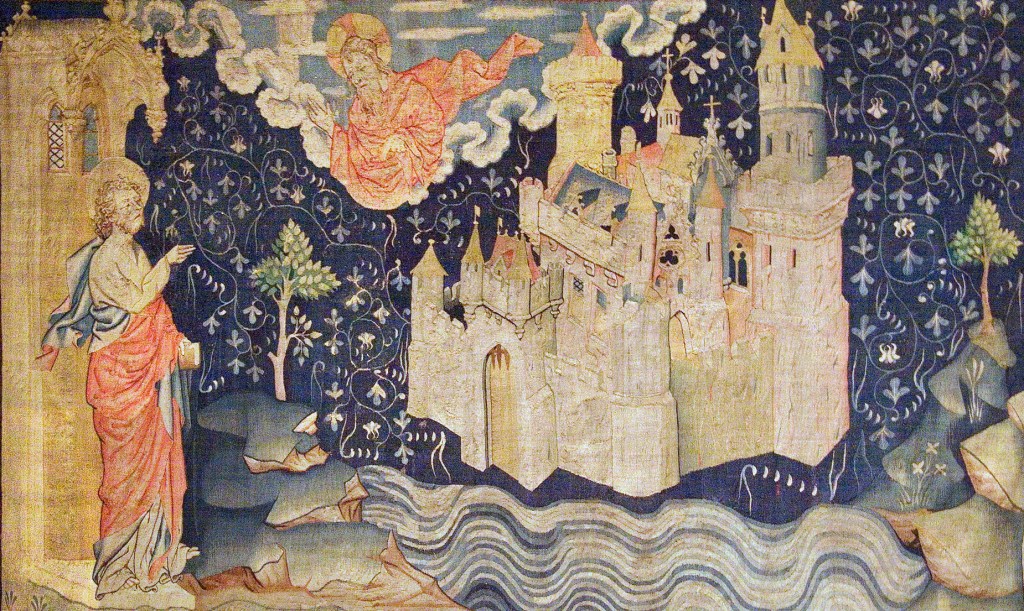
Cover image is The Apocalypse Tapestry, 1373–1382. By Bondol, Jean (designer), and Nicolas Bataille (weaver). Château d’Angers, Angers, France. Source image found here.
This essay is part 4 of a four-part series that deals with apocalyptic thought and its influence on modern society. You can read the other essays from the links below:
Part 1: The Origins of Apocalyptic Thinking
Part 2: Who Was the Historical Jesus
Part 3: Is the Rapture Actually in the Bible?
This essay develops themes explored more fully in my recently published book, The Last Apocalypse: Consciousness, Revelation, and the Future of Humanity.
 Building the Future Now
