
Warfare has always been shaped by technological innovation. From metallurgy and explosives to aviation, computing, and satellite navigation, militaries have consistently sought new technologies that provide an advantage on the battlefield. Today, another transformation is underway. The rapid development of unmanned aerial vehicles (UAVs), ground and naval drones, and the emergence of artificial intelligence are changing not only how wars are fought, but also who fights them, where they are fought, and how decisions about life and death may ultimately be made.
The war between Russia and Ukraine has become the world’s largest testing ground for many of these technologies, offering a glimpse into what future conflicts may look like. While drone warfare has the potential to reduce the exposure of soldiers to direct combat, it also expands the battlefield, lowers the cost of projecting military power, and raises difficult ethical questions about increasingly remote and autonomous warfare. These are developments that deserve careful attention, because their implications extend well beyond the current conflict.
The Drone Revolution
The development of military drones is not a recent phenomenon. During World War II, the United States experimented with radio-controlled aircraft, and in the early 1950s the U.S. Air Force introduced the Ryan Firebee, a jet-powered drone primarily used as an aerial target. As the Cold War intensified, surveillance became a major focus, leading to the development of unmanned aircraft capable of gathering intelligence while reducing the risks faced by pilots. During the Vietnam War, these systems expanded beyond reconnaissance to include electronic warfare, leaflet distribution, and decoy missions designed to expose enemy air defenses.
The modern era of drone warfare began in the 1990s with the introduction of the General Atomics Predator. Unlike its predecessors, the Predator could not only observe the battlefield but also strike targets. During the Global War on Terror, drones became an increasingly important tool for surveillance and precision strikes against high-value targets, culminating in larger and more capable systems such as the MQ-9 Reaper.
For much of this period, the United States emphasized highly sophisticated and extremely expensive drone platforms. More recently, however, another model has emerged. Rather than pursuing the most technologically advanced systems possible, countries such as Iran have focused on producing inexpensive drones that can be manufactured in large numbers. Even when individually limited in capability, these systems can force an adversary to expend air-defense missiles costing millions of dollars to destroy drones worth only tens of thousands. Ukraine has adopted a similar approach against Russia, and Taiwan is preparing for the possibility of doing the same in the event of a conflict with China. This shift is changing the economics of warfare by allowing relatively inexpensive systems to threaten far more costly military equipment.
Nowhere is this transformation more evident than in the war between Russia and Ukraine. The conflict has become an enormous laboratory for drone warfare, where innovations are tested, countered, and refined at a pace rarely seen in modern military history. First-person-view (FPV) drones have become ubiquitous, allowing operators to guide drones directly onto their targets. Unmanned ground vehicles now transport supplies, lay and clear mines, evacuate wounded soldiers, and even serve as remotely operated weapons platforms. Naval drones have likewise emerged as an increasingly important component of the conflict.
Perhaps most striking is the speed of innovation. Each side continually adapts to the other’s latest technology, driving new ideas from conception to the battlefield in a matter of months rather than years. This stands in sharp contrast to the traditional military procurement process, where developing, testing, and fielding new equipment often takes many years. The result is a battlefield where technological evolution occurs almost in real time.
The Changing Role of the Soldier
Perhaps the most profound consequence of drone warfare is that it is beginning to separate the soldier from the battlefield itself. Soldiers remain essential to modern warfare, and no current conflict has eliminated the need for infantry, armor, or artillery. Yet in Ukraine, drones are increasingly carrying out missions that would once have required soldiers to expose themselves directly to enemy fire.
In some sectors of the front, the density of drone surveillance and attack has created broad areas where movement by foot or vehicle is exceptionally dangerous. Both sides rely heavily on unmanned systems to cross these zones, delivering supplies, evacuating wounded personnel, conducting reconnaissance, or striking enemy positions. In some ways, these areas resemble the “No Man’s Land” of the First World War, where advancing soldiers faced overwhelming danger. The difference today is that increasingly it is robot that cross these deadly spaces instead of humans.
Some Ukrainian military leaders have even suggested that future frontlines may require dramatically fewer soldiers than they do today, with unmanned systems performing many of the most dangerous combat tasks. Occupying and securing territory will almost certainly continue to require soldiers on the ground, but the direct delivery of firepower may increasingly come from operators located miles from the battlefield.
For thousands of years, the soldier has been the central figure of warfare, whether armed with a spear, sword, bow, rifle, or tank. Drone warfare represents one of the first genuine departures from that tradition. The person delivering lethal force is no longer necessarily standing on the battlefield. Instead, they may be sitting in a command post many miles away, viewing the conflict through a screen. What this shift will ultimately mean for military strategy, for the psychology of combat, and for society’s understanding of war remains an open question.
The Expanding Battlefield
If drone warfare has the potential to remove soldiers from parts of the battlefield, it also has the potential to expand the battlefield itself. One of the defining characteristics of the war in Ukraine has been the increasing importance of factories, power grids, transportation networks, communication systems, and other infrastructure that sustain military production. As both Russia and Ukraine have sought to degrade each other’s ability to produce drones, ammunition, and other military equipment, these systems have become increasingly important strategic targets.
This reflects a broader shift in the nature of warfare. Success is no longer determined solely by which army can outmaneuver the other on the battlefield, but also by which nation can sustain industrial production, adapt its technology, and replace its losses more quickly. In many respects, war is becoming as much a contest of manufacturing capacity, engineering, logistics, and supply chains as it is of soldiers and weapons.
The economics of drone warfare reinforce this trend. A drone costing only a few thousand dollars may require an interceptor missile costing hundreds of thousands or even millions of dollars to destroy. This imbalance creates enormous incentives to develop cheaper methods of defense while simultaneously increasing the importance of maintaining the factories, energy systems, and transportation networks that make large-scale drone production possible.
The result is a troubling paradox. As technology removes more soldiers from direct combat, it also broadens the range of places that become strategically significant during war. The battlefield no longer ends at the front lines; it increasingly extends into the industrial and civilian systems that support the war effort.
The Future of Warfare
If the war in Ukraine demonstrates anything, it is that innovation in warfare is no longer measured in decades but in months. Each technological advance is quickly met with a countermeasure, which is then answered with another innovation. The result is a battlefield where adaptation has become as important as the technology itself.
Many of these developments are already changing the balance of military power. Relatively inexpensive drones now allow smaller nations and even non-state actors such as terrorist organizations and criminal cartels to field capabilities that were once reserved for the world’s largest militaries. Precision strike capability is becoming increasingly affordable, lowering the barriers to projecting military force.
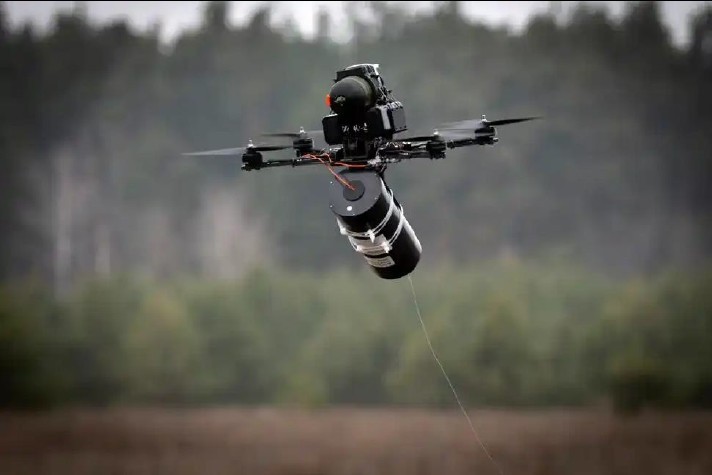
The pace of innovation shows no sign of slowing. Naval drones are beginning to transform maritime warfare, while fiber-optic-guided drones have emerged as a response to electronic jamming, trailing cables across fields and villages as they remain physically connected to their operators. New tactics and technologies appear on the battlefield almost as quickly as they can be conceived.
One reason for this rapid evolution is that militaries are increasingly encouraging innovation from the bottom up. Rather than waiting years for formal procurement programs to produce new equipment, the US military is starting to adapt commercially available drones to meet immediate battlefield needs. Throughout history, soldiers have demonstrated remarkable ingenuity in solving tactical problems, and inexpensive drone technology has dramatically expanded what small units can accomplish with limited resources.
The next stage of this evolution may prove even more consequential. Artificial intelligence is already being incorporated into drone systems to assist with navigation, target recognition, and autonomous operation. Swarms of coordinated drones acting together could overwhelm traditional defenses, while increasingly autonomous systems may reduce the amount of direct human control required to carry out attacks.
Conclusion
While researching this essay, I watched a documentary about a Ukrainian drone unit responsible for striking Russian soldiers and military vehicles. The operators were young, many in their twenties, a generation that had grown up playing video games. Sitting behind computer screens, they guided drones toward targets miles away from their position. Their mission was understandable in that they were defending their homeland and fighting to reclaim occupied cities.
Yet the technology itself raises unsettling questions. The physical distance created by drone warfare also creates psychological distance. Throughout history, soldiers have generally confronted the terrible reality of violence face to face. Drone operators experience war differently. Watching a battlefield through a screen inevitably changes the experience of combat, and it may also change our relationship to killing itself.
This concern is reinforced by aspects of drone culture that have emerged during the war. First-person-view footage is regularly shared on social media, while some military units have experimented with reward systems resembling the “kill streaks” and point systems familiar to many video games. These developments do not erase the reality that war remains horrific, but they do illustrate how technology can blur the boundary between genuine combat and virtual experience.
Drone warfare presents a striking paradox. It has the potential to make war safer for soldiers by removing them from some of the most dangerous parts of the battlefield. At the same time, it expands the battlefield into factories, power grids, transportation networks, and civilian infrastructure. It makes entire societies more directly involved in sustaining the war effort. War becomes increasingly remote for those fighting it, while becoming increasingly immediate for everyone else.
Looking ahead, the questions become even more profound. As artificial intelligence becomes integrated into drone systems, humans may increasingly surrender not only the act of fighting but also parts of the decision-making process itself. At what point does assistance become autonomy? At what point do we become comfortable allowing machines to determine when and how deadly force should be used?
Drone warfare is unlikely to disappear. If anything, it represents the beginning of a much broader transformation in the nature of war. More fundamentally, it illustrates a pattern that extends well beyond the battlefield: our technological capabilities are advancing more rapidly than our moral and ethical frameworks. We are developing increasingly sophisticated systems capable of finding, tracking, and killing human beings while only beginning to confront the ethical questions they raise. Whether humanity can develop the wisdom to govern these technologies may prove to be one of the defining challenges of the twenty-first century.
Cover image is of a fiber optic spool-fed drone from the US Army. Source image found here.
This is part 1 of a four-part series that deals with the rapid development in the technology of war and its implications for humanity. You can read the other essays from the links below:
Part 2: The Weaponization of AI
Part 3: What Does Autonomous Warfare Look Like?
Part 4: The Last Arms Race: Teaching AI to Wage War
This essay develops themes explored more fully in my recently published book, The Last Apocalypse: Consciousness, Revelation, and the Future of Humanity.
 Building the Future Now