Tariffs are once again in the news because President Trump recently implemented them against a number of our trading partners. The argument behind tariffs are that while they may raise consumer prices in the short-term, they will result in more manufacturing jobs in the long-term.
In reality they are a form of regressive tax which means they hit poorer people harder than they do wealthy people. This is because tariffs are a tax that is most often passed on to the end consumer. Me and you.
Prices for basic goods will go up, meaning all the things we need to live our daily lives will cost more. Think about how this will impact people on a fixed income such as elderly retirees. Or how it will affect a single parent raising a child. Or someone just trying to work their way out of poverty.
Wealthy people, on the other hand, can absorb these costs better because they are less of a share of their overall income. But for the rest of us, a 10% or 25% increase in basic goods will hit our wallets very hard.
Add to this regressive tax the Republican budget that is being debated that extends Trump’s tax cuts from his first term. These tax cuts heavily favor the rich. Both of these factors, the tariffs and the tax cuts, represent a redistribution of wealth upward.
In regards to tariffs bringing back domestic production, manufacturing output in the United States actually hit an all time high in 2023. The issue is that automation and now artificial intelligence has shrunk the number of workers needed in the production process. Looking at the chart below, it is easy to see the decline in manufacturing jobs in juxtaposition to a steady increase in manufacturing.
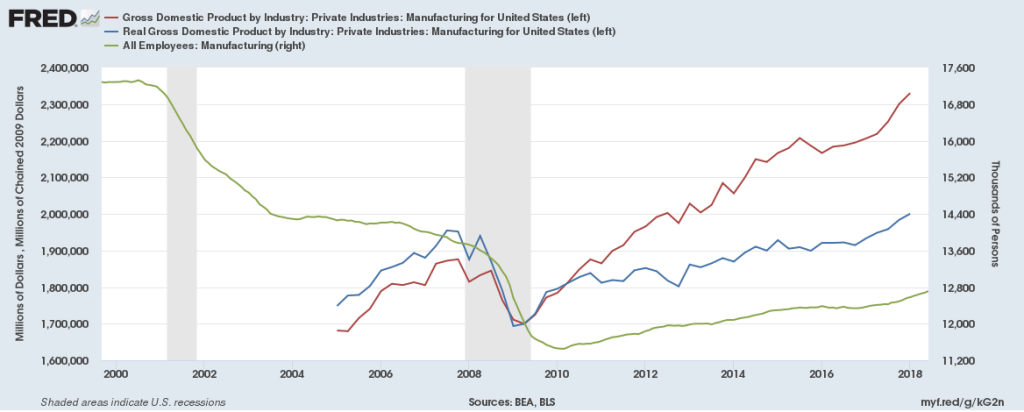
Figure 1: Chart showing the decline of manufacturing employment (red), the increase of manufacturing as gross domestic product (green), and as real gross domestic product (blue).
So, the idea of a manufacturing renaissance in America that rebuilds the middle class is a good narrative to sell, but only if you don’t factor in automation and AI. In reality, this is just another shift of wealth upward.
Sources:
Figure 1
From Wikipedia, ultimate source is Federal Reserve Economic Data
_and_Manufacturing_Employment.png)
 Building the Future Now
Leave a comment